
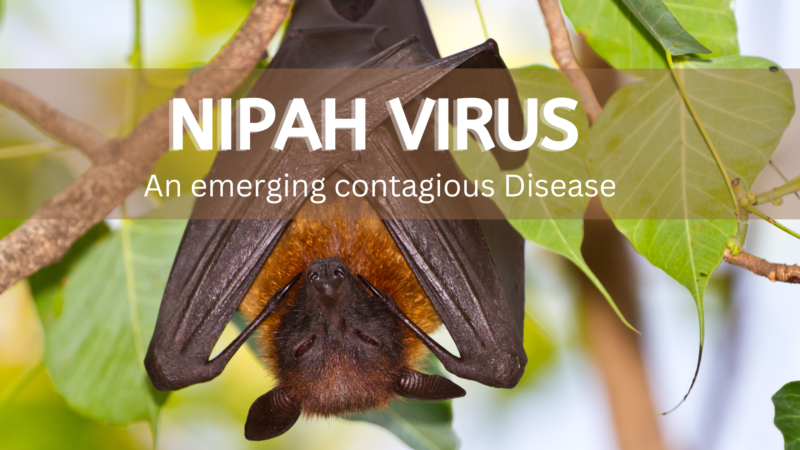
What is Nipah Virus
Nipah has been named by the World Health Organization, the WHO, as one of the most dangerous emerging pathogens that we know of, and that’s because of its ability to transmit from person-to-person. Nipah virus is a zoonotic disease that is spread from animals to human and human to human. It is an infectious disease of fruit bats which spread to the other animals like pig and from domestic infected animals to human. Now it is spreading from person to person.
Spread of Nipah Virus
Nipah virus is spread by infected:
-
- Fruit Bats animals (Flying foxes)
-
- Pigs
-
- drinking date palm sap
Causes of spread of Nipah Virus
-
- Nipah virus is a bat-borne virus and humans are infected through drinking date palm sap that’s collected from date palm trees, which is contaminated by the saliva or urine of Pteropus bats.
-
- Nipah virus is spread by direct contact with infected animals or their body fluids ( bats, pigs)
-
- Consumption of fruits or vegetables contaminated by the body fluids of infected animals
-
- Close or direct contact with infected person such as their body fluids or nasal secretions.
Sign and Symptoms of Nipah Virus
-
- fever
-
- headache
-
- vomiting
-
- sore throat
-
- cough
-
- difficulty breathing
-
- encephalitis
-
- disorientation
-
- drowsiness
-
- mental confusion
-
- seizures
-
- coma
-
- death
Nipah virus has initial symptoms of fever, headache and vomiting within first 3-14 days. Patient may also present with respiratory symptoms like sore throat, cough and difficulty in breathing. In later phase encephalitis develops within 24-48 hours. Chances of relapse or developing delayed onset encephalitis are common in cured persons.
An estimated rate of 40% to 75% of case fatality rate has been reported. The rate can vary depending on local capabilities for epidemiological surveillance and clinical management of the outbreak.
Diagnosis of Nipah Virus
-
- Real time polymerase test
-
- Cerebrospinal fluid
-
- Urine culture
-
- Blood culture
-
- Enzyme linked immunosorbent assay
-
- Polymerase chain reaction(PCR)
-
- Seroneutralization (plaque reduction neutralization test (PRNT))
-
- Virus isolation by blood culture
Treatment of Nipah virus
Currently, no approved treatment regimens are available for Nipah virus (NiV) infection. WHO has identified Nipah as a priority disease for the WHO Research and Development Blueprint in the 2018 annual review. Treatment is limited to intensive supportive care, including rest, hydration, and treatment of symptoms as they occur. However, a few immunotherapeutic treatments (monoclonal antibody therapies) are currently under development and evaluation for treating NiV infections.
Treatment Trials
-
- Ribavirin: During the NiV outbreak in Malaysia in 1998/99, ribavirin was given empirically
to treat 140 patients. The trial is non-randomized. Mortality was lower in the treated
group (32%) compared to the controls (54%), corresponding to a 36% reduction.
- Ribavirin: During the NiV outbreak in Malaysia in 1998/99, ribavirin was given empirically
-
- Convalescent plasma has not been investigated clinically during outbreaks of NiV
infections.
- Convalescent plasma has not been investigated clinically during outbreaks of NiV
-
- Monoclonal antibodies targeting the surface glycoproteins showed efficacy against both
Hendra and Nipah viruses as pre-and post-exposure prophylaxis on animal models for
the experiment.
- Monoclonal antibodies targeting the surface glycoproteins showed efficacy against both
-
- Monoclonal Antibodies m102.4 have potent neutralizing and cross-neutralizing activity
against both Hendra virus and Nipah viruses has been demonstrated in both ferrets and
NHPs infected with either Hendra or Nipah viruses.
- Monoclonal Antibodies m102.4 have potent neutralizing and cross-neutralizing activity
-
- In humans, m102.4 has been used in Australia (10 people exposed to Hendra virus) at
high-dose therapy under compassionate protocol where all survived with no associated
adverse events.
- In humans, m102.4 has been used in Australia (10 people exposed to Hendra virus) at
-
- The double-blind, placebo-controlled, single-center, and dose-escalation phase 1 trial of
m102.4 was all implemented in Australia in 2015-16. Dosing was well tolerated and safe,
displayed linear pharmacokinetics, and showed no evidence of an immunogenic
response.
- The double-blind, placebo-controlled, single-center, and dose-escalation phase 1 trial of
Prevention of Nipah Virus
General Measures
In areas where Nipah virus (NiV) outbreaks have occurred people should:
-
- Practice regular handwashing with soap and
water
- Practice regular handwashing with soap and
-
- Avoid contact with sick bats and pigs and their geographic location
-
- Avoid areas where bats are known to roost
-
- Avoid contaminated fruits and vegetables by bats
-
- Avoid contact with the body fluids of Niv infected
-
- Using face mask and Personal Protective Equipment (PPE) to avoid infection while
working in a healthcare setting where infection is suspected or detected.
- Using face mask and Personal Protective Equipment (PPE) to avoid infection while
Surveillance of Nipah Virus
-
- Specific case definition
-
- Suspect cases must be identified first
-
- Case definition of disease
-
- Laboratory confirmatory tests
Public Health Message
-
- Reducing the risk of bat-to-human transmission.
-
- Reducing the risk of animal-to-human transmission.
-
- Reducing the risk of human-to-human transmission
Control of Nipah virus
World health organization is focusing on control of spread of nipah virus in communities through strategic measures which include:
-
- Control of vector and reservior in nature
-
- Epidemiological investigations, surveillance and laboratory
-
- Behavioral and social Interventions
-
- Case detection and clinical management
Nipah Virus (NiV) Outbreaks
Nipah virus was identified in Malaysia and Singapore following an outbreak of disease in pigs and people in 1999. It became a public health concern as it resulted in more than 100 deaths. More than a million pigs were killed to control the outbreak.
Another outbreak was reported in Bangladesh in 2001 which was person to person transmission. Subsequent outbreaks are reported in India. Now the sixth outbreak of Nipah has been reported in India in 2023. According to WHO as of 27 September 2023,1288 contacts of the confirmed cases were traced, including high-risk contacts and healthcare workers, who are under quarantine and monitoring for 21 days. Since 12 September, 387 samples have been tested, of which six cases were positive for Nipah virus infection, and all remaining samples tested negative. Since 15 September, no new cases have been detected. According to the National Institute of Virology (NIV), Pune, the virus found in Kerala has been identified as the Indian Genotype or I-Genotype and is similar to the Nipah virus strain found in Bangladesh.
