
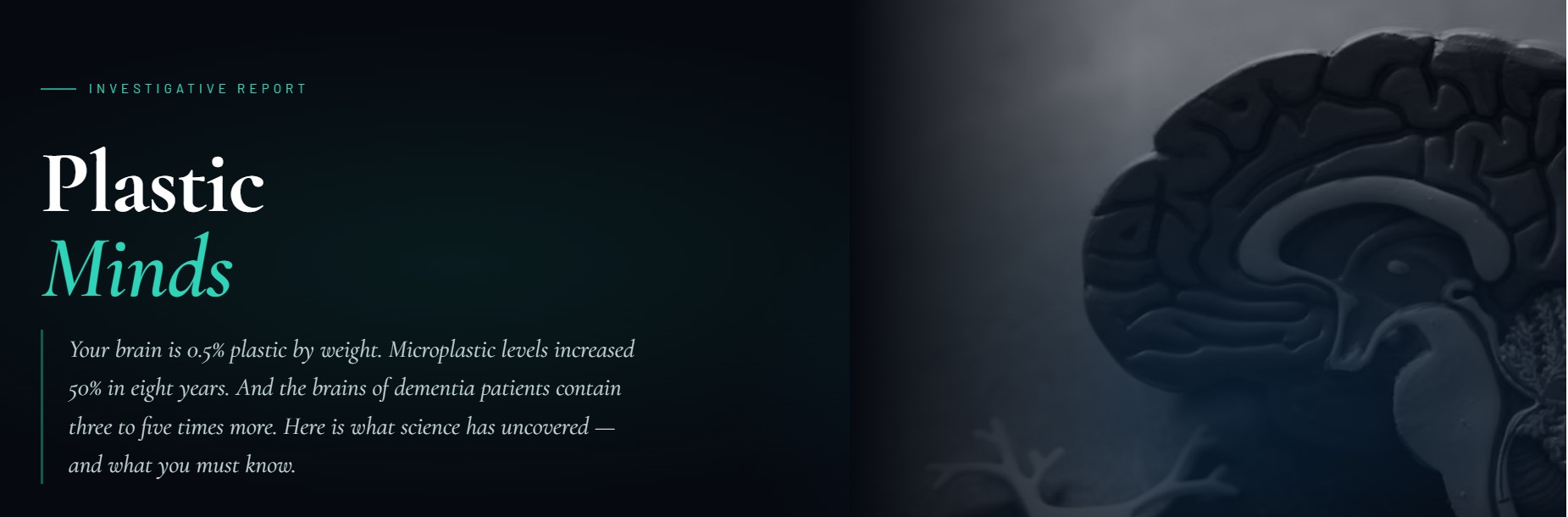
- A 2025 Nature Medicine study confirmed microplastics accumulate in the human brain — roughly a teaspoon’s worth in the average adult
- Brain microplastic levels rose 50% between 2016 and 2024, tracking global plastic production
- The brains of dementia patients contained 3 to 5 times more microplastics than neurologically healthy controls
- Six confirmed biological mechanisms explain how plastic damages brain tissue, including neuroinflammation, amyloid-β aggregation, and neurotransmitter disruption
- Bottled water, microwaving food in plastic, and ultra-processed foods are the three highest-exposure sources — and all are avoidable
- Twelve evidence-based actions can meaningfully reduce your daily microplastic exposure starting today
- How Microplastics Reach the Brain
- Can Microplastics Cause Dementia? What the Research Shows
- Six Biological Pathways: How Plastic Harms the Brain
- How Do Microplastics Affect Mental Health and Depression?
- The Exposure Risk Map — Where It Comes From
- 12 Evidence-Based Ways to Reduce Your Exposure
- What Research Is Coming Next
- Frequently Asked Questions
Microplastics in the human brain. That sentence would have seemed like the opening of a speculative science fiction story ten years ago. Today, it is the headline finding of a peer-reviewed study published in Nature Medicine — one of the most rigorous medical journals on earth — based on chemical analysis of real human brain tissue donated by real people. In February 2025, toxicologist Matthew Campen and his team at the University of New Mexico confirmed what many researchers had feared but none had formally proven: plastic polymer particles, primarily polyethylene, are distributed throughout the human frontal cortex in measurable, consistent, and repeatable concentrations. When they quantified the total, it came to roughly a full teaspoon of plastic per brain.
I want you to sit with that for a moment. A teaspoon. Inside the most complex object in the known universe — the organ that holds your memories, regulates your emotions, and makes you who you are — there sits a quietly accumulating mound of polymer particles that belong to shopping bags and water bottles, not to the architecture of thought.
And it is getting worse. The same study found that brain samples from 2024 contained approximately 50% more microplastic material than samples from 2016. In eight years. The rate of increase maps almost perfectly onto the curve of global plastic production, which has not slowed, not plateaued, not paused for a single year since the 1950s. The most alarming finding, however, was what the researchers found when they compared the brains of donors who had dementia at the time of death with those who were neurologically healthy: the dementia group had three to five times greater microplastic concentrations. Not slightly more. Dramatically more. Consistently, replicated across the sample.
This article is my attempt — drawing on the most current peer-reviewed research from Nature Medicine, Brain Medicine, Frontiers in Neurology, and Frontiers in Neuroscience — to give you an honest, complete, and useful account of what we know, what we don’t yet know, and what you can reasonably do about it. There is genuine reason for concern here. There is also reason for perspective. I will try to give you both.
How Microplastics Reach the Brain — Breaching the Fortress
For most of human history, the brain was considered impenetrable. The blood-brain barrier (BBB) — a dense layer of specialized endothelial cells lining the brain’s blood vessels — was understood as nature’s most sophisticated molecular checkpoint. Oxygen gets through. Glucose gets through. Most everything else gets turned away. Viruses struggle with it. Large protein molecules can’t breach it. The idea that nanoscale plastic particles from your tea bag or your water bottle could be routinely crossing this barrier and settling into brain tissue would have struck most neuroscientists as implausible even a decade ago.
It is no longer implausible — it is documented. The key word is size. Larger microplastic fragments (above roughly 1 micrometer) cannot physically cross the BBB. But nanoplastics — particles smaller than one micrometer — exploit the brain’s own transport machinery. The BBB uses a process called transcytosis to ferry nutrients across its endothelial wall. Nanoplastics appear to essentially impersonate legitimate cargo, triggering the same transport mechanisms and hitching a ride into the brain’s interior. A 2025 study using real-time fluorescent tracking in mice actually filmed this process happening — watching nanoplastics travel from the gut to the bloodstream to the brain.
Once inside, these particles appear to preferentially accumulate in the brain’s fatty tissue. The myelin sheath — the lipid-rich insulating layer that wraps around neurons and allows them to fire signals quickly and accurately — is particularly implicated. Myelin damage is central to multiple sclerosis, Alzheimer’s disease, and Parkinson’s disease. Finding plastic embedded in this structure is not a comfortable discovery.
Exposure arrives through three main routes. Ingestion is the biggest one — contaminated food and water accounts for the largest share of daily microplastic intake. Inhalation is more significant than most people expect: indoor air contains an estimated 97 to 170 microplastic particles per day, shed continuously from synthetic carpets, curtains, and clothing. Dermal contact with cosmetics and personal care products containing plastic microbeads is a third, less characterized route. Once in the bloodstream, microplastics distribute throughout the body — but the brain, according to the UNM data, accumulates them at concentrations 7 to 30 times higher than the liver or kidney. The organ we most need to protect appears to be the one least equipped to clear the threat.

Can Microplastics Cause Dementia? What the Research Actually Shows
This is the question everyone asks first, and it deserves a careful, honest answer. The short version is: we don’t have definitive proof yet that microplastics cause dementia in humans. What we do have is a striking, consistent, and biologically plausible correlation — and a rapidly growing body of animal evidence suggesting the relationship is more than coincidental.
Let’s start with what the UNM Nature Medicine study actually found. The dementia group — donors who had a documented dementia diagnosis at the time of death — had three to five times greater microplastic concentrations in their brain tissue than donors who died neurologically healthy. This disparity was consistent across the sample and was not explained by age, sex, or time of death. It demands an explanation, and there are two competing ones.
The first is that dementia damages the blood-brain barrier, making it more permeable and allowing more plastic through. Neuroinflammation — the chronic low-grade brain inflammation that is now understood as both a driver and a consequence of Alzheimer’s disease — is known to weaken BBB integrity. Under this model, the higher plastic load is partly a downstream consequence of the disease itself.
The second hypothesis is more troubling, and more interesting: that microplastics actively accelerate or contribute to dementia pathology through the biological mechanisms they trigger. The most compelling evidence for this comes from a 2025 University of Rhode Island study led by pharmacy professor Jaime Ross, who found that micro- and nanoplastic accumulation in genetically susceptible mice triggered cognitive decline and Alzheimer’s-like pathology. Critically, the damage was amplified in animals carrying Alzheimer’s risk genes — precisely the human population that would be most vulnerable.
A 2025 review in Frontiers in Neurology went further, formally designating chronic microplastic exposure as a novel modifiable risk factor for dementia — placing it in the same category as air pollution, which is now firmly established in the epidemiological literature as a contributor to Alzheimer’s risk. The truth, most researchers suspect, involves both hypotheses: a vicious cycle where neuroinflammation weakens the BBB, allowing more plastic in, which amplifies neuroinflammation further. Whether microplastics are the spark that starts the fire or the accelerant that makes it worse — or both — is what the next generation of research will tell us.
“Three to five times more plastic in dementia brains — measured directly from human tissue.”
What gives this finding particular scientific weight is its methodology. This isn’t based on dietary recall surveys or environmental exposure estimates. Researchers physically extracted polymer particles from postmortem brain tissue and measured them using chemical analysis. It is among the most direct forms of evidence available in environmental health research. Correlation is not causation — but this correlation has a mechanism, a dose-response pattern, and biological plausibility behind it. That combination takes it well beyond statistical noise.
Six Biological Pathways: Exactly How Plastic Harms the Brain
One of the reasons researchers are taking the microplastics-brain hypothesis so seriously is that the question isn’t just “are they there?” — it’s “what are they doing?” And the cellular evidence paints an increasingly detailed and troubling picture. There are at least six distinct biological mechanisms through which microplastic and nanoplastic particles may damage neural tissue. They do not operate independently — they appear to be mutually reinforcing, creating a web of damage that may be harder to reverse than any single-pathway problem.
Microplastics activate microglia — the brain’s resident immune cells — and trigger the NLRP3 inflammasome pathway, producing a sustained, low-grade inflammatory state in neural tissue. Chronic neuroinflammation is causally implicated in Alzheimer’s disease, treatment-resistant depression, and cognitive decline across multiple conditions.
Plastic particles generate reactive oxygen species (ROS) in brain tissue, systematically depleting the brain’s antioxidant defenses — superoxide dismutase, glutathione, and catalase. The brain, which consumes 20% of the body’s oxygen despite being only 2% of its weight, is unusually vulnerable to oxidative damage.
Nanoplastics physically interact with amyloid-beta proteins, accelerating their misfolding and aggregation into the plaques that define Alzheimer’s pathology. They may also impair microglia’s ability to clear existing amyloid deposits — interfering with both the formation and the cleanup of the disease’s primary pathological signature.
Microplastic exposure reduces acetylcholinesterase (AChE) activity — disrupting the acetylcholine system that is fundamental to memory and learning — while also impairing dopamine, serotonin, and glutamate signaling. This last point has direct implications for mood regulation, psychiatric vulnerability, and addiction.
Neurons are among the most energy-hungry cells in the body. Plastic particles impair the mitochondria that power them, disrupting synaptic transmission, impairing memory consolidation, and accelerating cell death. Mitochondrial dysfunction is a shared feature of Alzheimer’s, Parkinson’s, and major depressive disorder.
Microplastics carry passengers. Bisphenols (BPA, BPS), phthalates, PFAS compounds, and heavy metals adsorb onto plastic surfaces during their environmental journey and are released directly into brain tissue when particles accumulate. These endocrine-disrupting chemicals add a second, independent layer of neurological damage.
How Do Microplastics Affect Mental Health and Depression?
Most of the public conversation about microplastics and brain health focuses on dementia and neurodegeneration — which makes sense, given how striking that data is. But there is a quieter, parallel story emerging in the psychiatric literature that deserves equal attention: the possibility that microplastic accumulation is contributing to the global rise in depression, anxiety, and cognitive dysfunction in people who are decades away from any clinical neurodegeneration.
In May 2025, the journal Brain Medicine published a landmark collection of papers proposing a formal hypothesis: that ultra-processed food consumption, microplastic accumulation, and the rising global prevalence of depression share the same underlying biological mechanisms. The logic is tight. Ultra-processed foods are the single largest dietary source of microplastics — a chicken nugget, to take the most cited example, contains approximately 30 times more microplastic material per gram than a fresh chicken breast. The difference accumulates at every stage of industrial processing: the conveyor belts, the plastic-lined vats, the packaging, the heat-sealing machinery. Each contact point sheds particles into the food.
“We’re seeing converging evidence that should concern us all,” said Dr. Giovanni Fabiano, lead author of the Brain Medicine series. “Ultra-processed foods now exceed 50% of energy intake in countries like the United States. These foods deliver a microplastic dose that is measurably higher than whole food diets — and these particles can cross the blood-brain barrier and accumulate in alarming quantities.”
The mechanisms that link microplastics to depression are the same ones identified in the neurotoxicity research: neuroinflammation, oxidative stress, neurotransmitter disruption, and mitochondrial dysfunction. These are not merely theoretical — they are the same biological pathways that antidepressant medications, psychotherapy, and exercise are believed to address. In animal studies, polystyrene microplastic exposure has reproducibly produced anxiety-like behavior, reduced mobility, and gut microbiome alterations consistent with the gut-brain axis disruption seen in clinical depression. Researchers at Frontiers in Neuroscience formally concluded in 2025 that microplastic exposure should be considered a potential environmental risk factor for anxiety, cognitive impairment, and neurodevelopmental conditions — though they rightly emphasize that establishing direct causation in humans requires further clinical study.
What strikes me about this body of evidence is not any single finding but the coherence of the picture. We have a toxin entering the brain through multiple routes, hitting multiple biological targets, producing multiple neurological effects — including effects on the very neurotransmitter systems that govern how we feel, how we cope, and how clearly we think. Whether microplastics are a primary driver of the mental health crisis is still unknown. But the possibility that they are a contributing factor is no longer the fringe hypothesis it once seemed.


The Exposure Risk Map: Where Your Daily Plastic Load Actually Comes From
Not all plastic exposure is equal, and this matters enormously for personal risk reduction. The research has now mapped enough sources with enough precision that we can build a meaningful hierarchy of risk — and the results are, in some ways, reassuring. The highest exposures come from a small number of specific behaviors, most of which are easily changed. The lowest exposures come from things that are mostly unavoidable. Focusing your energy on the top of the list, not the bottom, is where the leverage is.
Microplastic Exposure Sources — Risk Hierarchy
Compiled from peer-reviewed literature, 2024–2026| Source | Estimated Exposure | Key Plastic Types | Risk Level |
|---|---|---|---|
| Bottled water (daily use) | +90,000 particles/year vs. tap | PET, polypropylene | High |
| Microwaving food in plastic | Billions of NPs per container | Polypropylene, polystyrene | High |
| Ultra-processed foods | 30× higher than whole foods | Polyethylene, PVC | High |
| Plastic tea bags in hot water | Up to 1.2 billion NPs per cup | Polypropylene, nylon-6 | High |
| Canned foods (daily consumption) | 1,000% rise in BPA in urine | Epoxy resins, BPA | High |
| Plastic cutting boards | Significant particle shedding during use | Polyethylene, polypropylene | Medium |
| Unfiltered tap water | ~4,000 particles/year | Mixed polymers | Medium |
| Indoor airborne particles | 97–170 particles/day | Synthetic textile fibers | Medium |
| Fresh fruit & vegetables | Low but measurable (via soil) | Mixed environmental polymers | Low |
| Boiled filtered tap water | Removes ≥80% of remaining NPs | — | Lowest |
⚠ An Honest Caveat — Read Before Sharing This Table
The microplastics field is moving fast, and not all findings are equally established. Some researchers have raised methodological concerns about contamination controls in human tissue studies. The FDA and WHO have not yet issued clinical guidance linking microplastic exposure to specific diseases. What you are reading represents the current best evidence — not settled clinical consensus. The case for individual risk reduction is sound. The case for panic is not.
What You Can Do Right Now: 12 Evidence-Based Actions, Ranked by Impact
Let me be direct with you about something. Total elimination of microplastic exposure is not possible. These particles are in the air, the soil, the rain, and the bodies of every living person on earth. Anyone selling you a “microplastic detox” is selling you nonsense. What the research does support is this: the gap between the highest and lowest realistic daily exposure levels is enormous, the actions that close that gap are specific and accessible, and the biological principle that less exposure means less accumulation is well-established. Here, ranked roughly by impact, are the interventions with the strongest evidence behind them.
Bottled water adds an estimated 90,000 extra microplastic particles per year to your intake. An NSF/ANSI 401-certified tap filter is a one-time investment that pays enormous dividends. Boiling filtered water removes at least 80% of remaining nanoplastics. When you’re out, glass or stainless steel — not a fresh plastic bottle.
Microwaving food in any plastic container — including those labeled “microwave safe,” which refers to the container not melting, not to safety from particle release — releases billions of nanoplastics per use. Transfer to glass, ceramic, or stainless steel before any heating. This is the single highest-leverage behavioral change.
Industrial food processing is a microplastic delivery system. Every stage — conveyor belts, plastic-lined vats, heat sealing, packaging — adds particles. Choosing minimally processed whole foods is not just beneficial for metabolic health; it is currently one of the most significant dietary microplastic reduction strategies available.
Plastic-mesh tea bags release up to 1.2 billion nanoplastic particles into a single cup of hot water. This is one of the most alarming single-source findings in microplastic research, and it is completely avoidable. Switch to loose-leaf in a metal strainer or paper-bag brands with no plastic sealant.
Plastic cutting boards are now well-documented sources of significant microplastic ingestion during food preparation. The same applies to non-stick PTFE pans and plastic utensils at high heat. Wooden or bamboo boards, cast iron or ceramic cookware, and stainless steel utensils are the straightforward replacements.
Daily canned food consumption has been shown to increase BPA and bisphenol urinary concentrations by up to 1,000%. Choose fresh, frozen in cardboard or paper, or glass-jarred alternatives whenever possible. If cans are unavoidable, BPA-free labeling offers partial but meaningful improvement.
Polyester, nylon, and fleece shed synthetic microfibers into indoor air continuously — during wear, during washing, and simply through movement. Homes with primarily synthetic textiles have measurably higher indoor microplastic concentrations. Cotton, linen, wool, and bamboo are the lower-exposure alternatives.
Even cold storage in plastic containers allows gradual chemical migration into food over time — particularly for fatty foods, which absorb lipophilic plastic additives more readily. Glass containers with glass or stainless lids are a straightforward substitution with no functional downside.
A robust gut microbiome appears to moderate the neuroinflammatory downstream effects of microplastic ingestion. Fermented foods (kefir, kimchi, yogurt), high-fiber diets, and Mediterranean-pattern eating support both gut integrity and baseline neuroinflammation levels. This won’t stop particles entering, but it may blunt their impact.
HEPA-filter vacuuming removes synthetic fiber particles from floors and surfaces before they become airborne again. Increasing ventilation dilutes indoor concentration. Removing shoes at the door keeps outdoor particulate matter — which carries environmental microplastics — from being distributed throughout the home.
Polyethylene, polypropylene, polyurethane, and acrylates appear on the ingredient lists of many scrubs, foundations, mascaras, and sunscreens. These are intentional inclusions — added for texture or performance. Check labels and choose certified plastic-free alternatives from brands that have reformulated.
Microplastics biomagnify: small fish accumulate particles from their environment, larger predatory fish accumulate from eating smaller fish, and so on up the chain. Tuna, swordfish, and other large predatory species carry higher microplastic loads than sardines, anchovies, or plant-based protein sources.
The Horizon: What Research Is Coming — and Why It Matters
The microplastics and brain research field has moved faster in the past three years than in the previous two decades. The combination of improved detection technologies, the jolt delivered by the Nature Medicine brain accumulation finding, and growing institutional funding has created an environment in which significant new findings are arriving faster than regulatory agencies or clinical guidelines can absorb them. Here is what is coming.
Causal Mechanisms in Living Humans
Prospective cohort studies are now tracking microplastic biomarker levels in living participants against cognitive and psychiatric outcomes over time — the study design needed to establish causation rather than correlation. Results from several major European longitudinal cohorts are expected between 2027 and 2028.
Therapeutic Apheresis
A 2025 Brain Medicine paper proposed therapeutic apheresis — a blood-filtration technique already approved for autoimmune conditions — as a potential method for reducing circulating microplastics before they cross into the brain. It is a speculative but scientifically grounded idea, and human feasibility trials are in early planning stages.
Who Is Most Vulnerable?
The URI Alzheimer’s mouse study established that genetic risk factors dramatically amplify microplastic-induced cognitive damage. Human genetic research is now mapping which polymorphisms — particularly those associated with neuroinflammation, BBB integrity, and lipid metabolism — make individuals more susceptible to microplastic neurotoxicity.
Federal Drinking Water Standards
Following a 2025 petition signed by seven US state governors, the EPA is under significant pressure to establish the first federal monitoring and maximum contaminant standards for microplastics in public drinking water. If enacted, this would represent a landmark moment in environmental health policy — decades overdue.
The Parkinson’s disease angle is attracting particular urgency. A 2026 review in npj Parkinson’s Disease, synthesizing more than 100 published studies, concluded that microplastics may be contributing to the near-doubling of Parkinson’s disease prevalence over the past 25 years. The proposed mechanism centers on nanoplastic particles promoting the misfolding of alpha-synuclein — the protein whose abnormal aggregation defines Parkinson’s pathology. If confirmed in human studies, this would extend the plastic-brain hypothesis beyond Alzheimer’s to encompass the most common movement disorder in the world.
There is also the question nobody has cleanly answered yet: can the brain clear microplastics, and if so, how? The short, sobering answer based on current evidence is: not well. Unlike the liver — which has dedicated phase I and phase II detoxification machinery — the brain appears to accumulate plastic particles without an efficient clearance mechanism. The glymphatic system, which the brain uses to clear metabolic waste during sleep, may play some role, but this has not been demonstrated for microplastics specifically. The implication is significant: prevention is dramatically more effective than any future treatment. What enters accumulates. What doesn’t enter can’t accumulate. That is the most powerful argument for acting on the available evidence now, rather than waiting for the complete scientific picture to arrive.
The Weight of What We Know — and What to Do With It
I want to end with the same commitment to honesty with which I began. This is not a settled scientific story. The causal chain from microplastic exposure to dementia or depression has not been formally proven in humans. The FDA has not issued warnings. The WHO has not issued guidelines. The science is serious and accelerating, but it is not complete.
What is complete, as of April 2026, is this: microplastics are in the human brain. They are there in quantities that have increased 50% in eight years. They are there in concentrations three to five times higher in people with dementia than in people without. The biological mechanisms through which they could plausibly cause damage — neuroinflammation, oxidative stress, amyloid aggregation, neurotransmitter disruption, mitochondrial dysfunction, endocrine disruption from their chemical cargo — are real, documented, and multiple. And the specific behaviors and products that drive the highest exposures are known and changeable.
That is enough to act on. Not to panic, not to catastrophize, not to buy an expensive and unproven “detox” supplement. But to switch to a water filter. To stop microwaving food in plastic. To eat less from factories and more from farms. To make the quiet, undramatic, cumulative changes that lower your daily plastic load — not because the case is closed, but because the evidence is already stronger than the evidence we required before we stopped smoking in restaurants or put seatbelts in cars.
The brain inside your skull right now contains more plastic than it did eight years ago, and less than it will eight years from now — unless something changes. You have more control over that trajectory than you might think.
The science is speaking clearly enough. The question is only whether we choose to listen.
Your Questions, Answered Directly
Based on the February 2025 Nature Medicine study from the University of New Mexico, the average adult brain contains microplastics equivalent to roughly 0.5% of its total weight — approximately a teaspoon’s worth of polymer material. Brain samples from 2024 showed about 50% more plastic than samples from 2016, confirming that accumulation is rising in step with global plastic production.
Direct causation has not yet been formally established in human clinical trials. However, the evidence is substantial and concerning: dementia patients’ brains contain 3 to 5 times more microplastics than neurologically healthy brains; nanoplastics in animal studies accelerate Alzheimer’s-like pathology, especially in genetically susceptible subjects; and a 2025 Frontiers in Neurology review classified chronic microplastic exposure as a novel modifiable dementia risk factor. Most researchers believe the relationship is causal, bidirectional, or both — but definitive human proof is still forthcoming.
Larger microplastic particles cannot cross the blood-brain barrier — they are physically too big. Nanoplastics (under 1 micrometer) are small enough to exploit the brain’s natural transcytosis transport mechanisms, essentially mimicking legitimate cargo to gain entry. Once inside, they appear to preferentially accumulate in fatty tissue including the myelin sheath surrounding neurons.
Emerging research suggests a genuine link. A 2025 Brain Medicine series connected ultra-processed food microplastic load with the same neuroinflammatory and neurotransmitter-disrupting mechanisms implicated in depression and anxiety. Animal studies have documented anxiety-like behavior and gut microbiome disruption following microplastic exposure. Researchers at Frontiers in Neuroscience now classify microplastic exposure as a potential environmental risk factor for anxiety and cognitive deficits, while acknowledging that human causation studies are still needed.
Stop microwaving food in plastic containers. This single behavior releases billions of nanoplastic particles per use directly into food — among the highest single-event exposure of any common daily activity. The second most impactful change is switching from bottled water to filtered tap water, which eliminates an estimated 90,000 extra particles per year. These two changes together address the highest-intensity exposures most people have.
Almost certainly yes. Children’s blood-brain barriers are still developing and are considered more permeable than those of adults. Exposure begins before birth — microplastics have been detected in placental tissue and amniotic fluid. It continues through breast milk, formula, plastic baby bottles, and children’s food packaging. Pediatric-specific microplastic neurotoxicology is an active and urgent research priority.
Current evidence suggests the brain has limited capacity to clear microplastic particles once they accumulate. Unlike the liver, which has robust detoxification pathways, the brain lacks an equivalent system. The glymphatic system — which clears metabolic waste during sleep — may play some role, but this has not been demonstrated for microplastics specifically. This makes prevention significantly more powerful than any anticipated future treatment: what doesn’t enter cannot accumulate.
The data here is genuinely alarming: plastic-mesh tea bags have been shown to release up to 1.2 billion nanoplastic particles into a single cup of hot water. Hot liquid dramatically accelerates particle shedding from plastic surfaces. Switching to loose-leaf tea in a metal strainer, or to brands using only paper bag materials with no plastic heat-sealing, completely eliminates this exposure source.
Sources & References
Nihart AJ et al., “Bioaccumulation of microplastics in decedent human brains,” Nature Medicine 31:1114–1119 (Feb 2025) · Fabiano G et al., “Microplastics and mental health: The role of ultra-processed foods,” Brain Medicine (May 2025) · Gecegelen E et al., “A novel risk factor for dementia: chronic microplastic exposure,” Frontiers in Neurology 16 (May 2025) · Fang et al., “Overall effects of microplastics on brain function,” Frontiers in Toxicology 7 (Nov 2025) · Ross JA et al., URI microplastics-Alzheimer’s mouse model study, University of Rhode Island (Sept 2025) · Lin et al., “Micro-nanoplastics and Parkinson’s disease — a systematic review,” npj Parkinson’s Disease (2026) · Lein PJ, “Are micro- and nanoplastics accumulating in the brain promoting neurological dysfunction?” Open Access Government (Apr 2026) · NRDC, Consumer Guide to Microplastics in Food and Water (June 2025) · Stanford Medicine, Microplastics and human health research overview (Jan 2025)
