
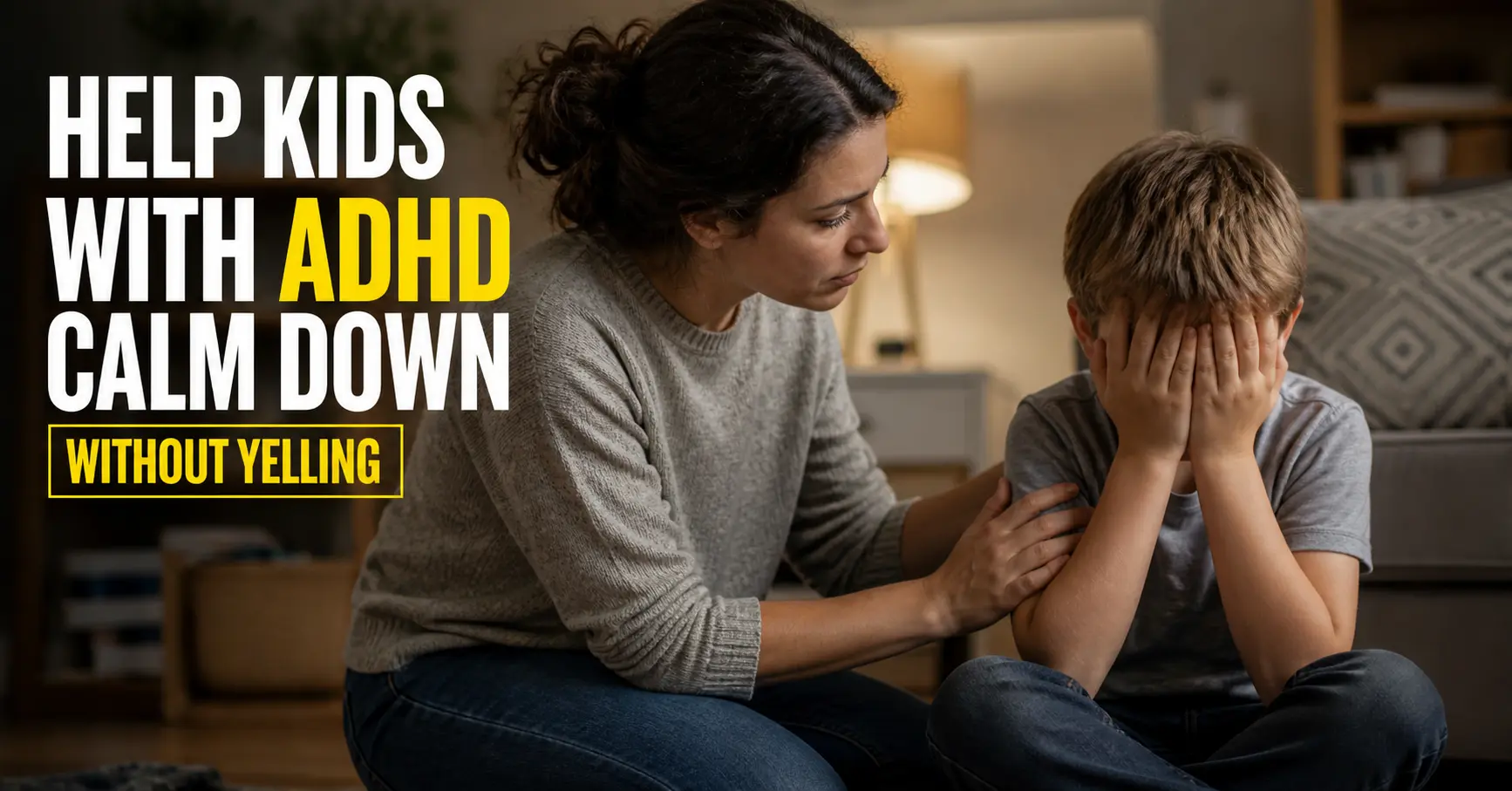
If your child with ADHD erupts in anger that seems too big, too fast, and too hard to stop — you are not dealing with a discipline problem. You are dealing with a brain that is wired differently. Children with ADHD have measurably weaker connections between the prefrontal cortex (the brain’s control tower) and the amygdala (the emotional alarm system), which means their anger fires faster, burns hotter, and takes longer to cool down than in children without ADHD. Understanding this biology is the single most important shift a parent can make.
What is ADHD-related anger?
ADHD-related anger is a pattern of intense, rapid-onset emotional outbursts driven by the core neurological features of ADHD — specifically impaired executive function and emotional dysregulation. It is not willful misbehavior. It is the predictable result of a brain that struggles to pause, reflect, and modulate an emotional response before it becomes an explosion.
A 2024 study from the University of Cambridge, published in Nature Mental Health 2024 · Nature Mental Health, found that 1 in 2 children with ADHD show clinically significant emotional dysregulation — making it one of the most common and most distressing features of the condition for families. Crucially, the same research found that standard ADHD medication is less effective at targeting emotional dysregulation than it is at targeting attention and hyperactivity, meaning many children and parents are managing this dimension largely without dedicated support. Despite this prevalence, emotional dysregulation is not listed in the DSM-5 diagnostic criteria for ADHD, so many families are never warned it is coming.
The neuroscience behind ADHD and anger
To understand why anger is so intense in children with ADHD, it helps to understand what is happening inside their brain. Three overlapping neurological factors drive the problem.
1. Underactive prefrontal cortex
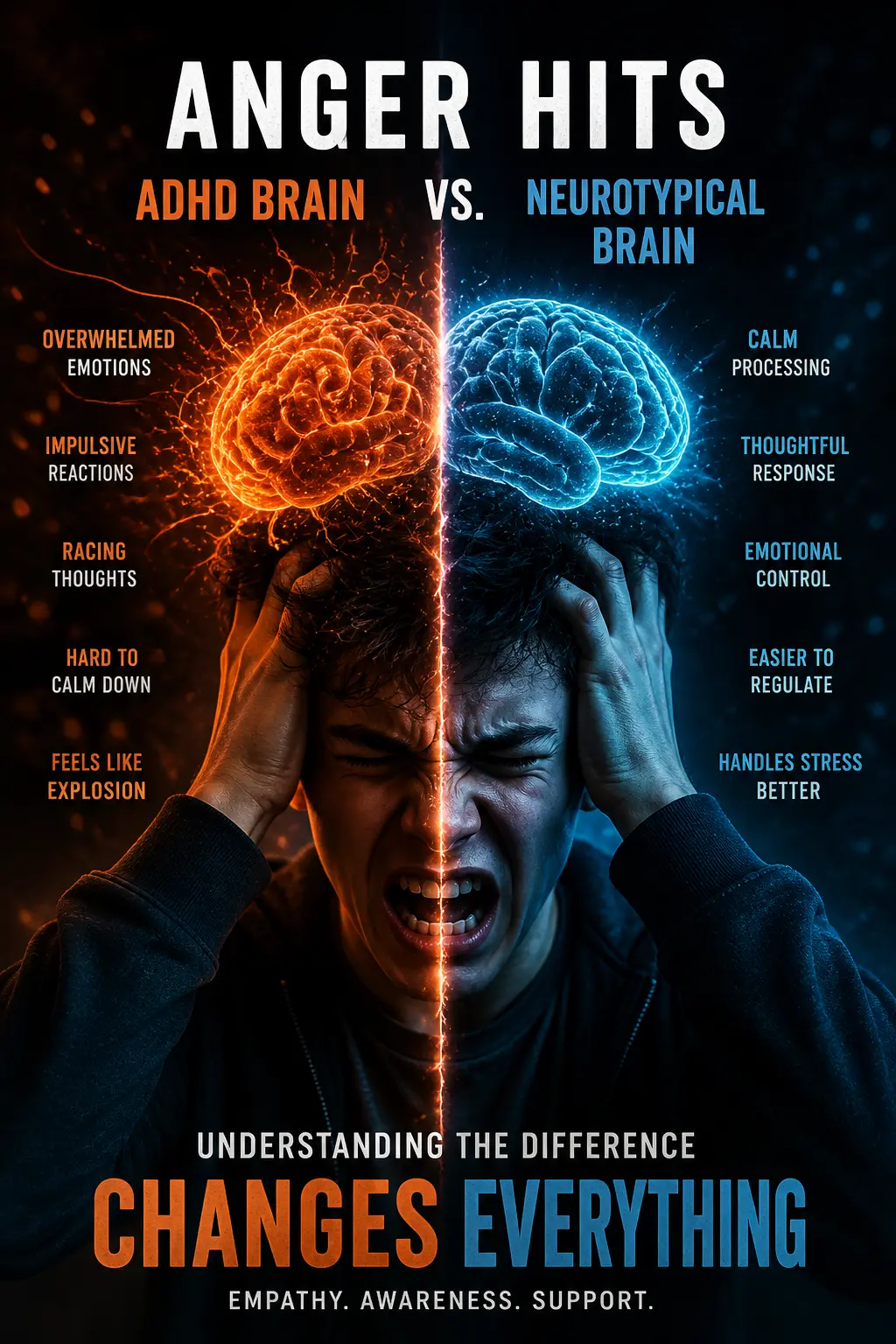
The prefrontal cortex (PFC) is responsible for impulse control, emotional braking, and thinking before acting. Neuroimaging studies show that children with ADHD have less blood flow and lower dopamine activity in the PFC compared to neurotypical peers. In practical terms, this means the brain’s “pause button” is slow to activate. When something upsetting happens, the emotional response launches before the rational response can catch up.
2. Overreactive amygdala
The amygdala is the brain’s threat-detection center. In children with ADHD, it responds more strongly and more quickly to perceived threats — including social slights, criticism, losing a game, or a change in plans. A 2026 study published in Psychological Medicine 2026 · Psychological Medicine by researchers from Fordham University and the Child Mind Institute found that children with ADHD who experience severe emotional outbursts show distinct differences in brain structure and connectivity — suggesting that ADHD with emotional dysregulation involves a separate neuroanatomical pattern, not simply more severe ADHD.
3. The emotional age gap
Research by Dr. Russell Barkley — one of the foremost ADHD researchers in the world — shows that children with ADHD typically display emotional self-regulation that is 30% behind their chronological age. A 10-year-old with ADHD may have the emotional regulation capacity of a 7-year-old. This is not immaturity in the colloquial sense — it is a genuine developmental lag with a neurological basis. Expecting a child to simply “control themselves” without accommodations is, neurologically speaking, like expecting someone to walk before their legs are ready.
ADHD anger vs temper tantrums: how to tell them apart
Parents often ask whether what they are seeing is a typical tantrum, an ADHD rage episode, or something that needs clinical attention. This comparison helps.
| Feature | Typical tantrum | ADHD anger episode |
|---|---|---|
| Onset | Gradual build-up around a specific want or need | Rapid — frustration, transition, or sensory input |
| Duration | Usually 5–15 minutes | 20–45+ minutes; child struggles to self-soothe |
| Trigger severity | Proportionate — big reaction to a real problem | Disproportionate — extreme reaction to small frustrations |
| Awareness | Child may pause if distracted | Child feels completely overwhelmed; redirection may escalate |
| Recovery | Back to play within minutes | Shame, exhaustion, or remorse afterward |
| Pattern | Peaks ages 2–4, then fades with development | Persists and may worsen at school age |
The ADHD anger cycle: 5 stages every parent should recognize
ADHD anger is not random — it follows a predictable pattern. When parents can identify where their child is in the cycle, they can intervene earlier and more effectively. Click each stage to learn what to look for and what to do.

Common ADHD anger triggers by age
Anger triggers in children with ADHD shift as children develop. Understanding what is typical at each stage helps parents anticipate and prevent outbursts rather than simply react to them.
Ages 3–6: preschool and early childhood
At this age, ADHD is often not yet diagnosed and anger is frequently misread as ordinary defiance. Key triggers include transitions (ending screen time, leaving a playground), being told no, overstimulating environments such as birthday parties or busy shops, and hunger or tiredness. The nervous system at this age has very little recovery capacity — keep environments predictable and low-stimulation where possible.
Ages 7–12: school age
School introduces a rich set of new triggers: academic frustration, peer conflict, perceived unfairness, losing at games, and homework. Children at this age are also becoming more aware of being “different,” which adds a layer of shame and self-consciousness that can fuel explosions. The gap between their intellectual ability and emotional regulation capacity is often most painful here.
Ages 13–17: adolescence
Adolescent hormones amplify emotional intensity for all teenagers — for teens with ADHD, the effect is compounded. Key triggers include social rejection, romantic relationships, academic pressure, perceived disrespect from adults, and the frustration of wanting independence while struggling with executive function. Physical aggression is less common at this stage; verbal aggression, door-slamming, and withdrawal are more typical.
Warning signs parents often miss
Because ADHD anger can appear to come out of nowhere, parents often miss the early signals. Watch for these pre-explosion indicators:
- Rigid thinking: The child becomes stuck on one outcome and cannot accept alternatives. “It has to be this way” thinking almost always precedes an explosion.
- Increased physical restlessness: Fidgeting escalates, the child leaves their seat repeatedly, or they begin pacing.
- Shorter verbal responses: A usually talkative child becomes monosyllabic — using cognitive resources to hold themselves together.
- Subtle regression: The child reverts to behaviors typical of a younger age — whining, baby talk, clinginess.
- Rejection sensitivity: They interpret neutral comments as personal attacks and react as if criticized or dismissed.
Catching the escalation stage — not the explosion — is where parents can make the biggest difference. The goal is not to manage the crisis; it is to prevent the crisis from occurring.
Dr. Ross Greene, author of The Explosive Child
10 evidence-based strategies for managing ADHD anger
These strategies are grouped by stage of the anger cycle. The earlier you intervene, the fewer tools you need.
At the trigger and escalation stage
- Give transition warnings. Five minutes before any change — dinner time, leaving the park, ending screen time — give a verbal and if possible visual warning. Children with ADHD have impaired time perception; transitions feel sudden even when adults have given notice. A visual timer on the kitchen counter removes the argument entirely.
- Reduce environmental load. Before a high-risk moment such as homework time or a family event, reduce stimulation — turn off background TV, clear the table, offer a snack.
- Name the feeling before it explodes. “You look like you are getting frustrated. Is that what is happening?” This activates the child’s verbal cortex — the same region that inhibits the amygdala — and gives them a label instead of a reaction. This technique is called affect labeling and has strong neuroscience support.
- Offer limited choices. “Do you want to finish your homework here or at the kitchen table?” Restores a sense of agency and reduces the power struggle dynamic.
At the peak stage
- Stay calm — your nervous system regulates theirs. Lower your voice rather than raising it. Slow your speech. Get physically lower than the child — kneel, crouch, or sit. Research on stress contagion shows that a parent’s own cortisol level is measurably transmitted to a child within minutes of an intense interaction.
- Do not reason during the explosion. During a peak anger episode, the prefrontal cortex is functionally offline. Explaining consequences, asking for eye contact, or delivering moral lectures at this moment is neurologically useless — and usually escalating. Wait until the child is in the recovery stage.
- Create physical safety, not physical restraint. Move breakable objects out of reach, ensure other children are safe, and give the child space if possible. Physical restraint — unless there is a genuine safety emergency — typically prolongs and escalates ADHD anger episodes.
- Use co-regulation tools you have already practiced. Deep belly breathing, a cold water splash on the wrists, or a specific movement such as running in place can interrupt physiological escalation — but only if the child already knows the tool. A child encountering a coping strategy for the first time during a rage episode will not use it.
At the recovery stage
- Re-connect before correcting. After an episode, offer physical closeness if the child accepts it — a hand on the shoulder, sitting nearby, a glass of water. Let the child know they are still loved and safe before you move into any discussion of consequences.
- Brief, non-punitive problem-solving. At least 20–30 minutes after the episode: “That was really hard. What do you think made it happen? What could we try next time?” Children with ADHD respond significantly better to collaborative problem-solving than to top-down consequence delivery.
What to say — and what to avoid — during an anger episode
The words parents use during an anger episode can either stabilize or escalate the situation. These specific phrases have been validated in parent training programs for ADHD.
- “I can see you’re really upset right now.”
- “I’m right here. I’m not going anywhere.”
- “You don’t have to talk. We can just be here together.”
- “Take your time. There’s no rush.”
- “I love you even when things are hard.”
- “Let’s take some big breaths together.” (Only if already practiced.)
- “Calm down.” (Never works — often escalates.)
- “You’re being ridiculous.”
- “Why do you always do this?”
- “Look at me when I’m talking to you.”
- “This is so embarrassing.”
- “I’ll give you something to cry about.”
Building long-term emotional regulation skills
In-the-moment strategies prevent crises. Long-term skill building prevents the pattern. These approaches, practiced daily, build the neurological infrastructure children with ADHD need for emotional regulation.
The calm-down kit
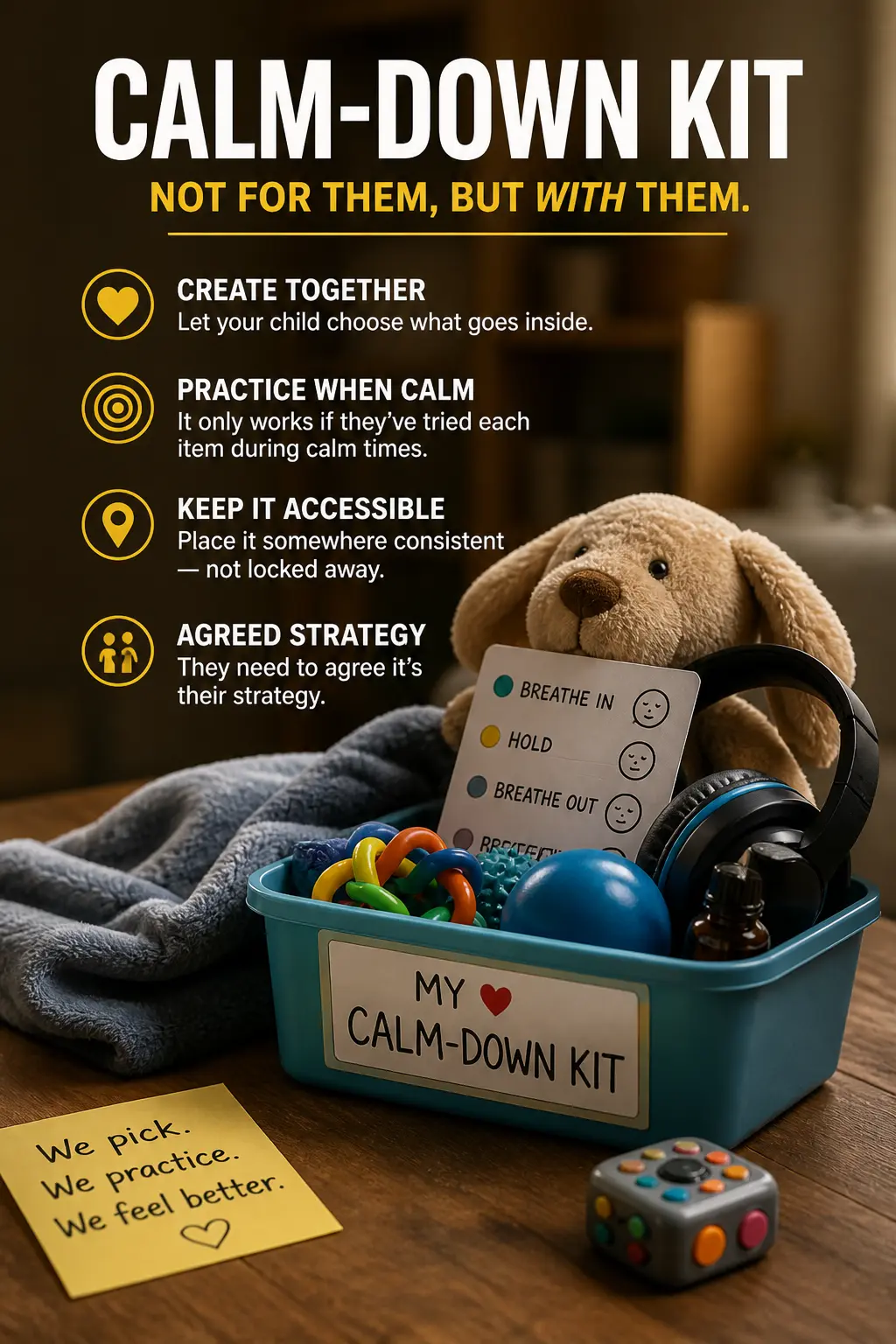
Create a physical kit with your child — not for them, but with them. Let the child choose what goes inside. Common items that work well include a stress ball, noise-canceling headphones, a fidget tool, a laminated card with three breathing steps, a soft fabric item, and a small bottle of a preferred scent. The kit only works if the child has practiced using each item during calm times and has agreed on it as a strategy. Place it in a consistent, accessible location — not locked away for emergencies.
Mindfulness adapted for ADHD brains
Standard mindfulness — sitting still, eyes closed, long sessions — is poorly suited to ADHD. A 2019 meta-analysis in Clinical Psychology Review 2019 · Clinical Psychology Review found that movement-adapted mindfulness protocols produced the strongest effects for ADHD emotional dysregulation. Start with 90 seconds: a brief body scan before breakfast, mindful colouring, or three slow breaths before a transition. Extend only when the child asks for more.
Consistent routine as emotional scaffolding
Predictability reduces the number of transitions and surprise triggers a child with ADHD encounters each day. A visual daily schedule posted at child eye-height reduces arguments, emotional outbursts, and demand avoidance significantly. Research consistently shows that external structure compensates for the internal executive function that is underactive in ADHD — the environment does what the brain cannot yet do alone.
Sleep — the most underestimated tool
Sleep deprivation has the same neurological effect on emotional regulation as ADHD itself — and children with ADHD are more likely to have disrupted sleep. A child who has lost even 30 minutes of sleep is measurably more emotionally reactive the following day. Sleep hygiene for ADHD includes consistent bed and wake times even on weekends, no screens 60 minutes before bed, and a cool, dark room. If your child consistently cannot fall asleep before 10pm, discuss sleep-onset delay with their paediatrician — it is common and treatable in ADHD.
Working with schools to support ADHD anger management
For most children, school is where ADHD anger peaks — because school demands sustained attention, compliance, transition, and social navigation for six or more hours a day. A proactive school plan prevents crises rather than simply responding to them.
Key accommodations to request in writing
- Movement breaks — a brief walk, a classroom errand, or a fidget tool prevents the sensory buildup that precedes explosions.
- Designated cool-down space — a named, non-punitive space the child can access before they explode, not after. Language matters: not “time-out” but “I need a break.”
- Reduced transition demands — extra time between subjects, advance notice of schedule changes, a written schedule on the child’s desk.
- Preferential seating — near the teacher, away from high-distraction areas, with easy access to the classroom door for breaks.
- A key trusted adult — one staff member the child can go to when overwhelmed. This relationship, built during calm moments, becomes the child’s primary de-escalation resource at school.
These accommodations can be formalised through an IEP (Individual Education Program) or a 504 Plan, depending on the country and school system. If your child’s anger significantly disrupts their learning or results in disciplinary action, a formal written plan is essential — verbal agreements with teachers change when teachers change.
Professional treatment options for ADHD-related anger
Behavioural parent training (BPT)
For children under 12, behavioural parent training is the first-line, most evidence-backed intervention for ADHD anger — recommended ahead of medication by the American Academy of Pediatrics. BPT programs including Triple P, Incredible Years, and Parent-Child Interaction Therapy train parents in differential attention, planned ignoring, consistent consequences, and positive reinforcement. Effect sizes are consistently large in controlled trials: Cohen’s d 0.6–0.9.
Cognitive Behavioral Therapy (CBT) for the child
For school-age children (generally 8 and older) and adolescents, CBT adapted for ADHD teaches anger identification, cognitive restructuring, and behavioural coping strategies. Standard CBT must be modified for ADHD — sessions are shorter, more structured, more concrete, and supported by visual tools and parent involvement. Several randomized controlled trials show significant improvement in parent-rated anger and emotional regulation.
Medication considerations
A 2025 study 2025 · PMC tracking psychiatrically hospitalised children aged 5–12 found that standing stimulant medication measurably shortened the duration of emotional outbursts, with extended-release formulations showing stronger effects. However, the 2024 Cambridge study in Nature Mental Health 2024 · Nature Mental Health found an important caveat: methylphenidate is significantly less effective at treating emotional dysregulation than at treating attention and hyperactivity — meaning medication alone is rarely sufficient for anger management. Non-stimulant options such as guanfacine and atomoxetine have specific evidence for emotional regulation.
Any medication decisions should be made in consultation with a paediatrician, child psychiatrist, or ADHD specialist who knows your child’s full clinical picture.
When to seek immediate professional help
- Your child is physically harming themselves, others, or animals during anger episodes
- Anger episodes are increasing in frequency or duration over several weeks
- Your child expresses that they wish they were dead or that life is not worth living
- You or other caregivers are being physically harmed on a regular basis
- The child’s anger is causing serious school impairment — suspension, school refusal, or inability to learn
- You suspect a co-occurring condition such as ODD, anxiety, or a mood disorder is present alongside ADHD
A note on parent self-care
Parenting a child with frequent anger episodes is physically and emotionally exhausting. Research on caregiver burnout in ADHD families shows that parents of children with ADHD report significantly higher rates of stress, anxiety, and depression than parents of neurotypical children — and that parental stress directly worsens child behaviour outcomes. This is not a cycle you break by trying harder.
You cannot regulate a dysregulated child if your own nervous system is in survival mode. Seeking your own support — through an ADHD parent support group such as CHADD or the ADHD Foundation, your own therapy, or simply talking to your child’s paediatrician about how you are coping — is not a luxury. It is a direct investment in your child’s outcomes.
- ADHD anger is neurological — impaired prefrontal cortex, overreactive amygdala, and an emotional age gap of ~30% behind chronological age.
- 1 in 2 children with ADHD have clinically significant emotional dysregulation (Cambridge · Nature Mental Health · 2024).
- ADHD anger follows a predictable 5-stage cycle — catching stages 1–2 is where parents have the most impact.
- In-the-moment: stay calm, name feelings, offer choices — more effective than punishment during an episode.
- Long-term: calm-down kits, consistent routines, adapted mindfulness, and adequate sleep build self-regulation capacity over time.
- Behavioural parent training is the first-line evidence-based treatment for children under 12 — ahead of medication.
- Standard ADHD medication is less effective for emotional dysregulation than for attention — combine with psychosocial treatment.
- Parent wellbeing is a direct variable in child outcome — not a secondary concern.
Frequently asked questions about ADHD and child anger
Anger and emotional outbursts are not listed in the DSM-5 diagnostic criteria for ADHD, but a 2024 study from the University of Cambridge published in Nature Mental Health found that 1 in 2 children with ADHD show clinically significant emotional dysregulation, including intense anger. This is driven by the same executive function deficits that cause inattention and impulsivity — and notably, standard ADHD medication is less effective at treating this symptom than it is at treating attention and hyperactivity.
Because their brain processes frustration differently. The amygdala in children with ADHD reacts more strongly and quickly to negative stimuli, while the prefrontal cortex is slower to activate. A 2026 study in Psychological Medicine confirmed that children with ADHD who experience severe outbursts show distinct brain structure differences — this is not a behaviour choice. Their emotional regulation also lags approximately 30% behind their chronological age, meaning they have less developed self-soothing capacity than peers.
For many children, yes — but with an important caveat. A 2025 study found stimulant medication measurably shortens emotional outburst duration in children aged 5–12. However, a 2024 Cambridge study in Nature Mental Health found methylphenidate is significantly less effective at targeting emotional dysregulation than at targeting attention and hyperactivity — meaning medication alone is rarely sufficient. Non-stimulant options including guanfacine and atomoxetine also have specific evidence for emotional regulation.
ADHD anger is typically reactive — triggered by frustration, overstimulation, or transition — and the child does not typically intend defiance. Oppositional Defiant Disorder involves a persistent pattern of arguing with authority figures, deliberately annoying others, and vindictiveness lasting at least six months. Approximately 40–60% of children with ADHD also have ODD. When both are present, professional evaluation is essential to disentangle and address each condition appropriately.
Once a meltdown has peaked, you cannot stop it — the prefrontal cortex is effectively offline and cannot be reasoned with. Your goals: safety, minimal escalation (no lecturing or threats), and calm physical presence. Allow the episode to pass. The most useful interventions happen before the peak — catching escalation early — and in the recovery stage, through brief calm problem-solving at least 20–30 minutes later. Consistent practice of coping strategies during calm periods is what changes the pattern over time.
ADHD anger most often peaks between ages 7–10, when academic and social demands increase sharply but emotional regulation capacity has not yet caught up. A second peak often occurs at ages 12–14, when puberty amplifies emotional intensity and the gap between the child’s desire for independence and their executive function capacity is at its widest.
Continue learning
This guide is the central pillar in our ADHD and child mental health series. Each article below goes deeper on a specific subtopic.
