
Table of Contents
We’ve all been there. You look in the mirror one morning and notice something new—a spot, a patch of redness, or a strange bump that wasn’t there yesterday. That moment often brings a familiar mix of curiosity and concern. We tend to think of our skin as a simple outer wrapper, a surface to be cleansed and moisturized. But if seeing a “spot” is our starting point, we’re already thinking about it the wrong way.
Think of your skin less as a wrapper and more as a dynamic, intelligent organ in constant communication. It reflects our internal health, reacts to our environment, and offers clues to our state of mind. Understanding its messages requires looking “beyond the surface” and learning to interpret its unique signals. This article will teach you the right way to think about skin, revealing five surprising truths from the world of dermatology that will reframe your understanding of your body’s largest organ.
1. Dermatologists Have a Secret Language for Your Skin
When we see a skin change, we might call it a “spot” or “bump.” To a dermatologist, these terms are like telling a mechanic your car is making a “weird noise”—they lack the necessary detail. For an expert to accurately diagnose a condition from thousands of possibilities, they must use a precise vocabulary to describe a lesion’s primary characteristics, or morphology. It’s the difference between a vague complaint and a specific observation, like telling the mechanic you heard a “high-pitched metallic screech during deceleration.”
This secret language begins with a few fundamental terms:
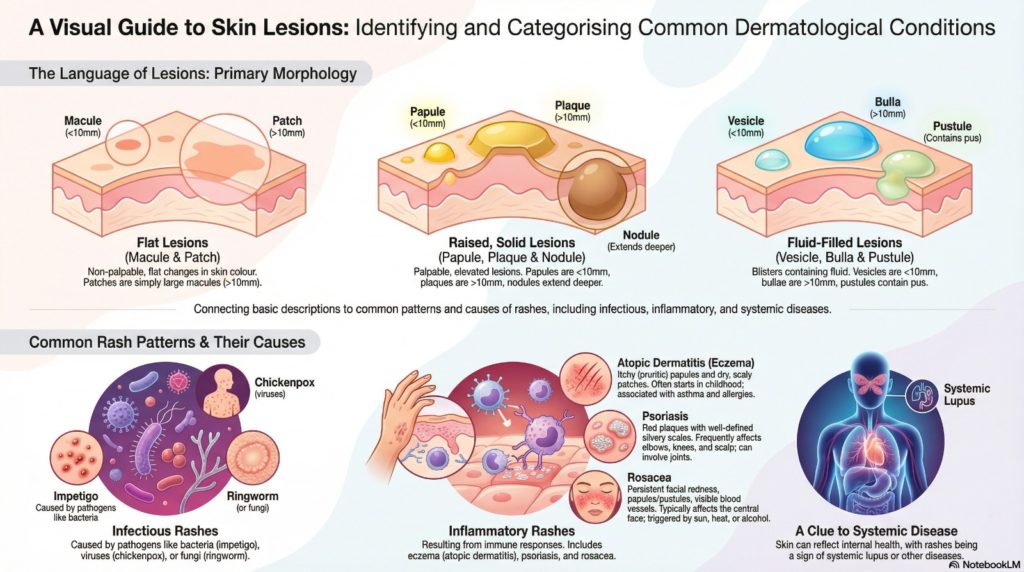
- Macule: A flat, non-palpable lesion usually < 10 mm in diameter. Macules are defined by a change in color, like a freckle. You can see it, but you can’t feel it.
- Papule: A small, solid, elevated lesion that you can feel, measuring less than 10mm in diameter. Common examples include insect bites or some types of warts.
- Plaque: A palpable, elevated lesion larger than 10mm. Often described as a raised, firm plateau, plaques are commonly seen in conditions like psoriasis.
- Vesicle: A small, fluid-filled blister less than 10mm across. These are characteristic of conditions ranging from viral infections like herpes to acute allergic contact dermatitis.
- Bulla: A large, fluid-filled blister greater than 10mm in diameter, often resulting from a burn or a severe allergic reaction.
But the diagnosis sharpens further. A clinician also notes a lesion’s configuration—its shape or arrangement. Lesions can be described in evocative ways, such as annular (ring-shaped) or as target lesions that look like a bull’s-eye. This precision isn’t just academic; it’s the first critical step in narrowing down the possibilities to find the right diagnosis.
2. A “Rash” Is a Clue, Not a Conclusion
“Rash” is one of the most common reasons people see a doctor, yet the word itself is not a diagnosis. The MSD Manual defines a rash as simply a “general term for a temporary skin eruption.” For a clinician, a rash is the start of an investigation, a collection of clues that must be pieced together to solve a medical mystery.
The diagnostic process involves a methodical approach where every detail matters. Key investigative steps include:
- The Story: A doctor will act like a detective, asking about recent travel that could suggest a tropical infection, new occupational exposures, or a detailed timeline of every medication—even over-the-counter ones—to uncover the trigger. They’ll also ask when it started, if it itches or hurts, and about any family history of skin conditions.
- The Pattern: The distribution of the rash provides vital clues. Is it localized or widespread? Is it symmetrical? Does it appear only on sun-exposed skin? Psoriasis, for example, frequently affects the elbows and knees.
- The Appearance: The physical characteristics are examined closely. The color, shape (well-defined borders may point to a fungal infection), and texture (raised, flat, or scaly) all contribute to the diagnostic puzzle.
This is an empowering takeaway for patients. The more details you can observe and share about your “rash”—its story, pattern, and appearance—the more effectively you can partner with your doctor to uncover the cause. And just as the details of a rash point to a specific cause, sometimes the rash itself is a clue pointing to something much deeper happening within the body.
3. Your Skin Is a Window to Your Overall Health
It’s easy to assume a skin problem is just that—a problem with the skin. However, dermatology often reveals that skin issues are not just skin-deep. The skin can be a powerful diagnostic tool, offering the first visible clues of diseases affecting other systems in the body.
As an article in the journal An Bras Dermatol states:
“The skin demonstrates what is happening in the body in many diseases, as it reflects some internal processes on the surface.”
This means a skin examination can lead to the identification of a systemic condition that might otherwise go unnoticed. Thousands of skin conditions have been described, and many are linked to our internal health. A few examples include:
- Rheumatologic diseases like lupus erythematosus can cause characteristic skin manifestations.
- Endocrine-related conditions, such as Cushing’s syndrome, can present with distinct skin findings.
- Gastrointestinal conditions like inflammatory bowel disease can manifest with specific skin lesions, directly linking gut health to skin health.
- Certain skin changes can even be the first sign of an internal malignancy, a phenomenon known as a paraneoplastic syndrome.
A dermatologist’s assessment can be crucial not only for treating the skin itself but for flagging deeper health issues that need attention from other specialists.
4. Many Skin Conditions Are an “Inside-Out” Job
We often think of skin conditions as the result of something external—an irritant or allergen—attacking from the outside. But for many chronic skin diseases, the real issue is an “inside-out” job, where the body’s own internal systems are the source of the problem.
Atopic Dermatitis (AD), or eczema, is a perfect case study. It is now understood as an “inflammatory skin disease with a systemic component.” The disease is driven by two key internal factors working together:
- A Compromised Barrier: Genetics can play a major role. For instance, some people have mutations in the filaggrin (FLG) gene, a protein crucial for a healthy skin barrier. Without enough of it, the skin becomes dysfunctional, unable to hold moisture in or keep irritants out.
- An Overactive Immune System: This dysfunctional barrier acts like an open door, allowing allergens and irritants to penetrate the skin, which in turn triggers the second internal problem: an immune system that is already primed to overreact. In people with AD, specific immune pathways, like Th2 and Th17, go into overdrive. This internal hyper-response is what causes the inflammation, redness, and intense itch that characterize an eczema flare-up.
This “inside-out” understanding is transformative. It explains why treatments are shifting from only topical creams to new “targeted biologic therapies” that work from the inside to calm the specific parts of the immune system that are overreacting. This “inside-out” reality of skin disease doesn’t stop at the immune system; it extends deeply into our mental and emotional lives, showing how the skin’s health is profoundly connected to our well-being.
5. The Profound Connection Between Skin, Mind, and Well-being
The impact of a chronic skin condition often extends far beyond physical discomfort. Pruritus—the medical term for itch—is the hallmark symptom of Atopic Dermatitis, and its effects can cascade through every aspect of a person’s life, creating a significant psychosocial burden for patients and their families.
The consequences of this relentless itch can be devastating:
- Sleep Disturbances: Intense itching frequently disrupts sleep, not just for the child with AD but for the entire family. Studies show that mothers of children with AD are significantly more likely to report difficulty falling asleep and daytime exhaustion.
- Social & Emotional Impact: Visible skin lesions can lead to painful social experiences, including bullying, social isolation, and lower self-confidence for children and adolescents. This has also been linked to a higher likelihood of conditions like ADD/ADHD.
- Mental Health: The chronic stress, poor sleep, and social stigma associated with AD are linked to a higher incidence of depression and anxiety, particularly in adolescents.
Treating a skin condition, therefore, is never just about clearing the skin. It’s about restoring a person’s quality of life, improving mental well-being, and giving back restful sleep to an entire family.
Conclusion
We’ve learned that our skin communicates with the precision of a trained physician, using a specific language of lesions and patterns. These messages aren’t just about the surface; they are bulletins from our internal world, revealing the state of our systemic health and, as we’ve seen, bearing the profound weight of our mental and emotional lives.
By moving beyond a surface-level view, we can appreciate the complex messages our skin sends every day. This deeper understanding not only empowers us to take better care of our skin but also encourages us to listen more closely to the stories it tells about our health as a whole. The next time you look in the mirror, what story might your skin be trying to tell you?
