

Our patient is 28 years old and has spent the last three years quietly rearranging his life around his stomach. He knows every public bathroom on his commute. He eats the same four foods that feel safe. He cancels plans more than he makes them. When his colleagues ask why he’s lost so much weight, he says he’s been eating healthier. His GP has run bloods twice. Both times, nothing alarming came back. “Probably IBS,” she says. “Try reducing stress.” He nods. He goes home and wonders, not for the first time, whether the cramps that keep him doubled over at 2am are real — or whether he is imagining the severity of something that medicine keeps calling ordinary.
That feeling — that something is categorically different — is almost certainly correct. What is happening inside his gut has a name, a biological mechanism, and a treatment pathway. It has been there for years. It just hasn’t been found yet.
A Patient’s Story — When the Gut Speaks and Nobody Listens
He was a young man in his mid-twenties who arrived at my clinic carrying something you learn to recognise after years in medicine: the careful, slightly guarded manner of someone who has been told too many times that nothing is wrong.
He described a pattern of symptoms that had begun gradually eighteen months earlier. Recurrent cramping abdominal pain — not constant, but arriving in waves, worst in the lower right quadrant of his abdomen. Loose stools four to six times a day on bad days. Mucus in the stool, though no blood he could identify. Fatigue so heavy he described it as “like walking through sand.” He had lost nearly six kilograms without trying. Night sweats were interrupting his sleep two to three times a week. And then — almost as an afterthought, as though he thought I might dismiss it — he mentioned that his knee and ankle joints had been aching for months. He had assumed it was from sitting too long at his desk.
That last detail was the one that told me exactly where to look.
Joint pain in a young person with gut symptoms is not coincidental. It is one of the most characteristic extraintestinal manifestations — meaning signs of the disease occurring outside the intestines — of Crohn’s disease, a form of Inflammatory Bowel Disease (IBD). Up to 40% of patients develop at least one such extraintestinal symptom, including arthritis, skin lesions, or eye inflammation, often before or alongside their digestive complaints. Lancet · PMC Review · 2024
Our patient had already seen his GP twice and a gastroenterologist once. Each time, irritable bowel syndrome (IBS) had been raised as the most likely explanation. It is an understandable mistake. The symptoms overlap almost completely in the early stages. But IBS and IBD are fundamentally different conditions, and the difference matters enormously for treatment and long-term outcomes.
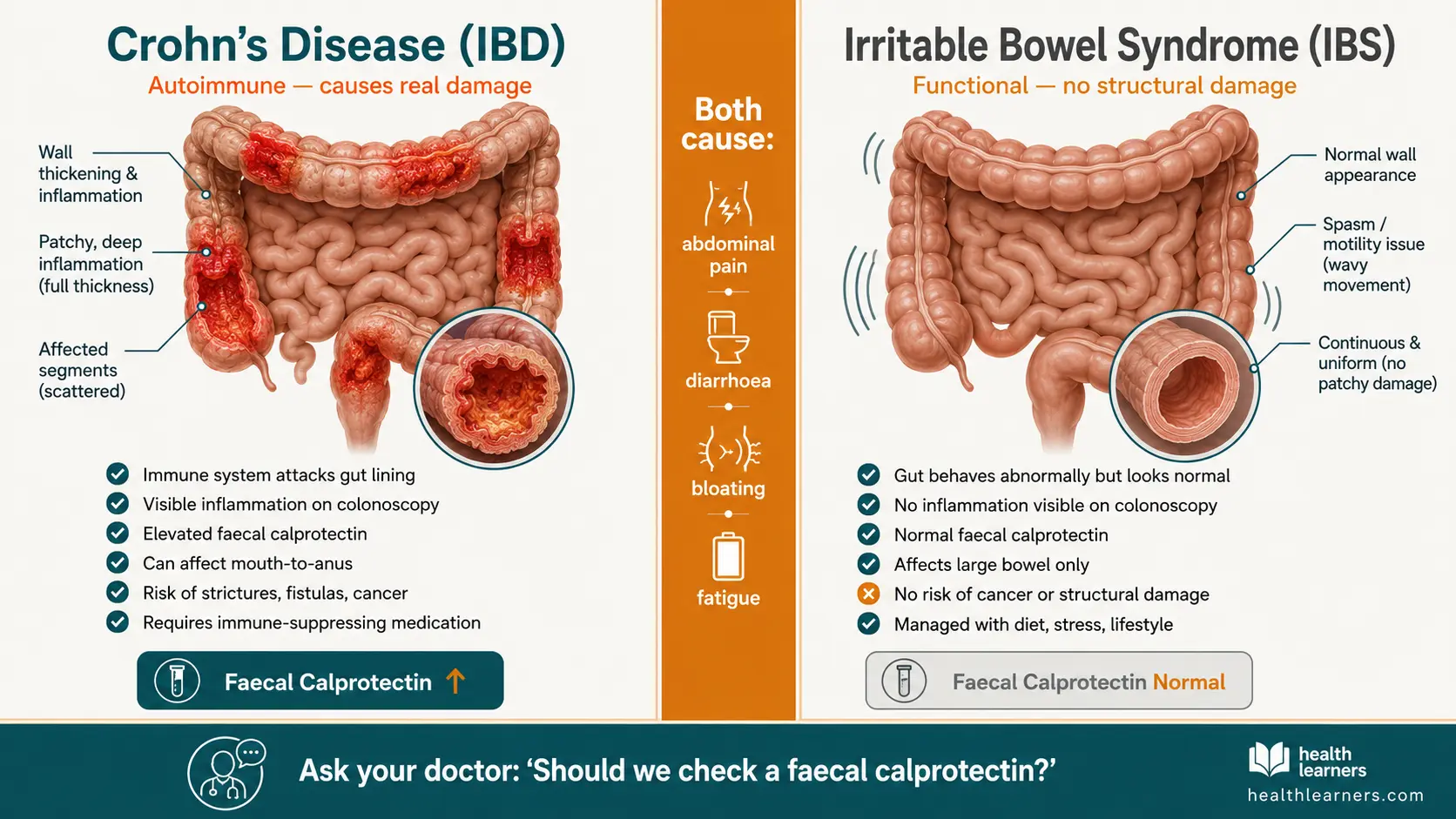
What IBD Actually Is — And Why It Gets Confused With So Much Else
Inflammatory Bowel Disease (IBD) is a chronic autoimmune condition in which the immune system mistakenly attacks the lining of the gastrointestinal tract, causing persistent inflammation and tissue damage. IBD has two main forms: Crohn’s disease, which can affect any part of the gut from mouth to anus and typically involves patches of deep, full-thickness inflammation; and ulcerative colitis, which is confined to the colon and rectum and causes continuous surface inflammation. Both are lifelong conditions with cycles of flare and remission. WHO · Lancet Gastroenterology · 2025
IBD is not a lifestyle disease. It is not caused by diet, stress, or weakness. It is an immune-mediated condition with a strong genetic component — people with a first-degree relative with IBD are up to four times more likely to develop it themselves. Environmental factors including antibiotic use, diet, and microbiome disruption play a role in triggering the disease in genetically susceptible individuals, but they do not cause it. Lancet Gastroenterol Hepatol · 2024
What makes IBD particularly difficult to diagnose early is that its initial symptoms — abdominal pain, diarrhoea, fatigue — are shared by a dozen other conditions. IBS. Coeliac disease. Food intolerances. Gut infections. Even anxiety disorders, which can produce genuine gut dysfunction. A 2024 qualitative study from Sheffield University found that diagnostic overshadowing is a primary driver of delay — when another diagnosis is already in play, like IBS or stress, the risk that IBD goes unrecognised rises dramatically. AWARE-IBD Working Group · PLoS ONE · 2024
For our patient, the IBS label had been functioning as a ceiling. Every symptom was being interpreted through it. The joint pain, the night sweats, the weight loss — features that do not fit IBS at all — had not been connected to the gut picture because the gut picture already had an explanation. That is how years pass.
The Diagnostic Journey — What Finally Led to the Answer
After taking a full history, I referred him for a combination of blood tests, stool tests, and imaging. The findings were telling: elevated CRP (C-reactive protein — a blood marker of inflammation in the body) and ESR (erythrocyte sedimentation rate — another inflammatory marker), elevated faecal calprotectin (a protein released by inflamed intestinal cells into the stool — a highly sensitive marker for IBD), and anaemia consistent with chronic disease. A colonoscopy — a camera examination of the large and small intestine — confirmed the diagnosis. Crohn’s disease, with the primary involvement in the terminal ileum — the last section of the small intestine, where it meets the colon, the region most commonly affected in Crohn’s. ACG Clinical Guidelines · 2025
The relief on his face when I told him what we had found is not something I forget easily. Not relief that it was serious — relief that it was real. That three years of pain had a name. That he had not been imagining it.
If you have been through that journey yourself — years of appointments that end with “try managing your stress,” while your body continues to do something your doctor cannot yet categorise — that moment of validation is not a small thing. It is, for many patients, the first breath they have taken properly in years.
“IBD is just a fancy name for a sensitive stomach. Diet and stress management should fix it.”
IBD is an autoimmune disease — not a functional disorder. Without treatment, uncontrolled intestinal inflammation causes permanent structural damage to the gut wall, leads to complications including strictures (narrowing of the intestine), fistulas (abnormal tunnels between organs), abscesses, and in the long term, increased colorectal cancer risk. Diet and stress management are important adjuncts. They do not treat the underlying immune dysregulation. ACG Guidelines · AGA Living Guideline · 2025
The Four Stages of IBD: From First Symptoms to Flare
IBD does not declare itself loudly at the start. It tends to build, with early symptoms that are easy to attribute to other causes, before escalating into something that can no longer be ignored. Understanding how it typically progresses helps explain both why diagnosis is delayed and why early intervention is so important.
Occasional loose stools, mild cramping, slight fatigue. Symptoms are intermittent and often attributed to dietary indiscretion, stress, or a “sensitive stomach.” Blood tests at this stage may be completely normal. Most patients do not seek medical attention yet — and those who do are frequently reassured without investigation. This is the window where early detection would have the most impact, and where it most commonly fails. AWARE-IBD Working Group · PLoS ONE · 2024
Summary — Four Stages of IBD Progression
- Stage 1 — Early Signs: Occasional loose stools, mild cramping, slight fatigue. Symptoms are intermittent and frequently misattributed. Blood tests may appear normal. This is the highest-value window for early detection — and where the diagnosis is most often missed.
- Stage 2 — Escalation: Symptoms become more frequent and predictable. Diarrhoea occurs daily. Abdominal pain intensifies and localises. Fatigue is constant. Weight loss begins. Extraintestinal signs — joint pain, skin or eye symptoms — may appear. Faecal calprotectin begins to rise measurably.
- Stage 3 — Full Flare: Significant inflammation is active and causing visible tissue damage. Bowel frequency reaches 6+ times daily. Blood or mucus in stool. Fever, night sweats, and severe fatigue. Risk of complications — strictures (intestinal narrowing), abscesses, fistulas. Hospitalisation may be required. This is typically when IBD is finally diagnosed in delayed cases.
- Stage 4 — Remission: With appropriate treatment, inflammation is controlled and symptoms significantly reduce or disappear. Remission is the treatment goal — not cure, which does not currently exist. Monitoring continues because flares can occur without warning. Regular colonoscopies are required for long-term colorectal cancer surveillance.
What Treatment Looks Like in 2025–2026
IBD management has changed profoundly over the past decade. The 2025 American College of Gastroenterology clinical guidelines for Crohn’s disease represent the most significant update since 2018, and the changes reflect a fundamental philosophical shift in how the disease is approached. ACG Clinical Guideline · 2025
The old model was step-up therapy: start with the mildest drugs, escalate only when they fail. The new model, supported by the 2024 PROFILE trial published in Lancet Gastroenterology & Hepatology, favours earlier use of advanced therapies — particularly biologics — in moderate-to-severe cases, before irreversible gut damage accumulates. PROFILE Trial · Lancet Gastroenterol Hepatol · 2024
- Biologics (TNF inhibitors): Infliximab and adalimumab reduce inflammation by targeting tumour necrosis factor — a key driver of the immune attack on the gut lining. First-line advanced therapy for moderate-to-severe Crohn’s
- Anti-integrin therapy: Vedolizumab targets immune cells specifically in the gut, with a favourable safety profile
- IL inhibitors: Ustekinumab and newer IL-23 inhibitors for patients who fail TNF therapy
- JAK inhibitors: Oral small-molecule agents (upadacitinib) — an emerging option that avoids injection
- Immunomodulators: Azathioprine and methotrexate, often combined with biologics to prevent resistance
- Dietary therapy: Exclusive enteral nutrition — a complete liquid diet — used particularly in children and young adults to induce remission
- Mesalamine (5-ASA) for Crohn’s: Still widely prescribed in community practice but strongly not recommended by the 2025 ACG guideline — no evidence of efficacy in Crohn’s beyond placebo
- Long-term corticosteroids: Steroid use should be limited to less than 3 months — prolonged use causes serious systemic side effects without modifying disease course
- Step-up therapy in moderate-severe cases: Waiting for mild treatments to fail before starting biologics allows progressive gut damage to accumulate irreversibly
- Treating IBD with diet alone: No diet cures IBD or replaces medical therapy — dietary changes support wellbeing but do not control inflammation
For our patient, treatment began with a combination of a TNF inhibitor — infliximab, administered as an intravenous infusion — and an immunomodulator to prevent the body from developing antibodies against the biologic. Within three months of starting therapy, his bowel frequency had reduced to once or twice a day. Within six months, his fatigue had lifted enough that he returned to work full-time. His joint pain resolved almost entirely. He is currently in remission.
Remission is not cure. He will need monitoring for life. His colonoscopies are scheduled every two years because Crohn’s disease is associated with a significantly elevated risk of colorectal cancer over decades. He knows this, and he has made peace with it — because knowing changes everything. Managing a chronic illness is infinitely more bearable than living inside one that has no name.

When to Seek Medical Attention — The Symptoms That Should Never Wait
Not every bout of diarrhoea or stomach cramp is IBD. But there are combinations of symptoms that warrant proper investigation rather than watchful waiting — and the sooner that investigation happens, the better the long-term outcomes.
- Diarrhoea or loose stools lasting more than 4 weeks — especially if occurring more than 3 times daily
- Abdominal pain that is localised (particularly lower right), recurrent, and not explained by diet
- Unintentional weight loss of 5% or more over 3–6 months
- Blood or mucus in the stool on more than one occasion
- Fatigue disproportionate to your activity level, combined with any gut symptoms
- Joint pain, skin rashes, or eye inflammation alongside digestive complaints
- Gut symptoms that have already been labelled as IBS but are worsening or not responding to typical IBS management
When you see your doctor, ask specifically: “Should we check a faecal calprotectin and CRP before concluding this is IBS?” These two tests take days to return and are the fastest way to separate functional from inflammatory gut disease.
The Two Tests That Change the Conversation
Faecal calprotectin measures a protein released by immune cells into the intestinal lining — when inflammation is present, levels rise sharply. It is non-invasive, inexpensive, and has a sensitivity of over 80% for detecting IBD in patients presenting with gut symptoms. CRP (C-reactive protein) and full blood count with ESR (erythrocyte sedimentation rate — a measure of how quickly red blood cells settle, elevated when inflammation is present) round out the initial picture. A normal faecal calprotectin in someone with diarrhoea is strong evidence against IBD and towards a functional disorder like IBS. An elevated one is a direct prompt for colonoscopy. ACG Clinical Guidelines · 2025 | Cross et al., 2023
Our patient’s faecal calprotectin was 847 μg/g — more than eight times the upper limit of normal. That single number, had it been measured eighteen months earlier, would have changed his path entirely.
- IBD (Crohn’s disease and ulcerative colitis) affects over 10 million people worldwide — and the global incidence is rising year on year
- Median diagnostic delay for Crohn’s disease is 8 months, but many patients wait years — primarily because early symptoms mirror IBS and other common conditions
- Up to one-third of IBD patients are initially misdiagnosed — the most common incorrect label is IBS
- Red flags that should prompt IBD investigation: localised abdominal pain, diarrhoea more than 4 weeks, unintentional weight loss, night sweats, joint pain alongside gut symptoms
- Faecal calprotectin and CRP are the key early blood/stool tests — a raised calprotectin in a patient with diarrhoea is a direct indication for colonoscopy
- IBD is an autoimmune disease — not a functional disorder. Diet and stress reduction are important supports but do not treat the underlying inflammation
- The 2025 ACG guidelines recommend against step-up therapy in moderate-severe Crohn’s — early biologic use leads to better long-term outcomes
- Remission is achievable for most patients with appropriate treatment. Living well with IBD is not just possible — for patients like him, and millions more, it became reality once the right question was finally asked
