

One health day is on November 3rd. It is a global campaign to bring attention to “one health approach: Right of everyone”. Life is possible when there is balance within the ecosystem. Human beings, animals and ecosystem interact and are linked with each other. This day is celebrated to bring all experts at single forum for communication and collaboration in the fields of animal, human and environmental health.
Table of Contents
Goal of One Health
Goal of one health is achieving optimal health outcomes recognizing the interconnection between people, animals, plants, and their shared environment ( US Government definition:2017).
Defining One Health Day
One Health Day is an international campaign focused on the interconnectedness of human, animal, and environmental health. It promotes a unified, interdisciplinary approach to tackling global health issues by acknowledging that health outcomes are often influenced by the interactions among people, animals, and our environment. Originating from concepts developed by pioneers like Rudolf Virchow and William Osler, One Health Day highlights the necessity of cross-sector collaboration to effectively address health challenges in today’s interconnected world.
Role Of One Health Day in Achieving Health For All
One Health Day plays a pivotal role in achieving “Health for All” by advocating for a holistic and collaborative approach to health issues. As populations and economies grow, so do demands on natural resources, which can lead to health challenges that cross human, animal, and environmental boundaries. By bridging these sectors, One Health Day promotes comprehensive solutions that can lead to better health outcomes, especially in vulnerable communities. The initiative encourages shared responsibility across medical, veterinary, and environmental sciences, creating a collective push toward achieving universal health coverage and sustainable health practices. By linking humans, animals and the environment, One Health can help to address the full spectrum of disease control – from prevention to detection, preparedness, response and management – and contribute to global health security.
Agencies working for One Health Day
- American Veterinary Medical Association (AVMA): AVMA leads efforts in veterinary health education and policy to address animal health while highlighting its impact on human and environmental health.
- Centers for Disease Control and Prevention (CDC): The CDC has established centers like the National Center for Zoonotic, Vector-Borne, and Enteric Diseases (NCZVED), which focus on emerging infectious diseases that affect both humans and animals.
- World Health Organization (WHO): WHO supports global health efforts through policies and research that integrate One Health principles, especially in managing infectious diseases
- These organizations work together and with other academic institutions, governmental agencies, and private sector partners to build robust One Health frameworks globally, ensuring that health solutions are multifaceted and sustainable.
Role of World Health Organization in One Health
The World Health Organization is playing its role in advancing the goals of One Health by setting health standards and fostering international collaboration on shared health threats. WHO focuses on creating health policies that account for the interconnectedness of human, animal, and environmental health. It also plays a critical role in managing and preventing zoonotic diseases through initiatives that integrate disease surveillance, public health response, and cross-sector communication. By supporting One Health, WHO helps to mitigate the global spread of diseases, emphasizing prevention and control strategies that benefit both developed and developing nations.
Role of CDC in One Health
The Centers for Disease Control and Prevention (CDC) is a key player in implementing One Health strategies within the United States and globally. Through the National Center for Zoonotic, Vector-Borne, and Enteric Diseases (NCZVED), the CDC addresses diseases that impact both human and animal populations, such as rabies, Lyme disease, and zoonotic influenza. The CDC’s efforts focus on early detection, rapid response, and interagency collaboration to combat outbreaks and develop effective prevention methods. The CDC also supports training and research that enhance understanding of disease ecology, contributing to a more integrated public health framework.
One Health Day in Achieving Control of Zoonotic diseases
One Health Day has a significant impact on controlling zoonotic diseases—those transmitted between animals and humans—by advocating for an interdisciplinary approach to disease management. Approximately 60% of all known infectious diseases in humans are zoonotic, and over 75% of emerging infectious diseases have animal origins, such as Ebola, SARS, and COVID-19. One Health Day promotes collaboration across medical, veterinary, and environmental fields to monitor, prevent, and respond to these threats more effectively. By integrating knowledge from these sectors, One Health can help establish protocols that prevent the spread of zoonotic diseases, thus protecting both animal and human health.
Saving Ecosystem through One Health Approach
One Health also emphasizes the importance of ecosystem preservation as a fundamental component of global health. Healthy ecosystems support biodiversity, which in turn can help regulate disease vectors and reduce the spread of infectious agents. For example, deforestation and habitat destruction often lead to increased human-wildlife contact, heightening the risk of zoonotic disease transmission. By conserving ecosystems and promoting sustainable practices, One Health advocates for a balanced environment where human, animal, and ecological health can thrive together. This approach not only helps in disease control but also supports biodiversity, which is essential for resilience against future health threats.
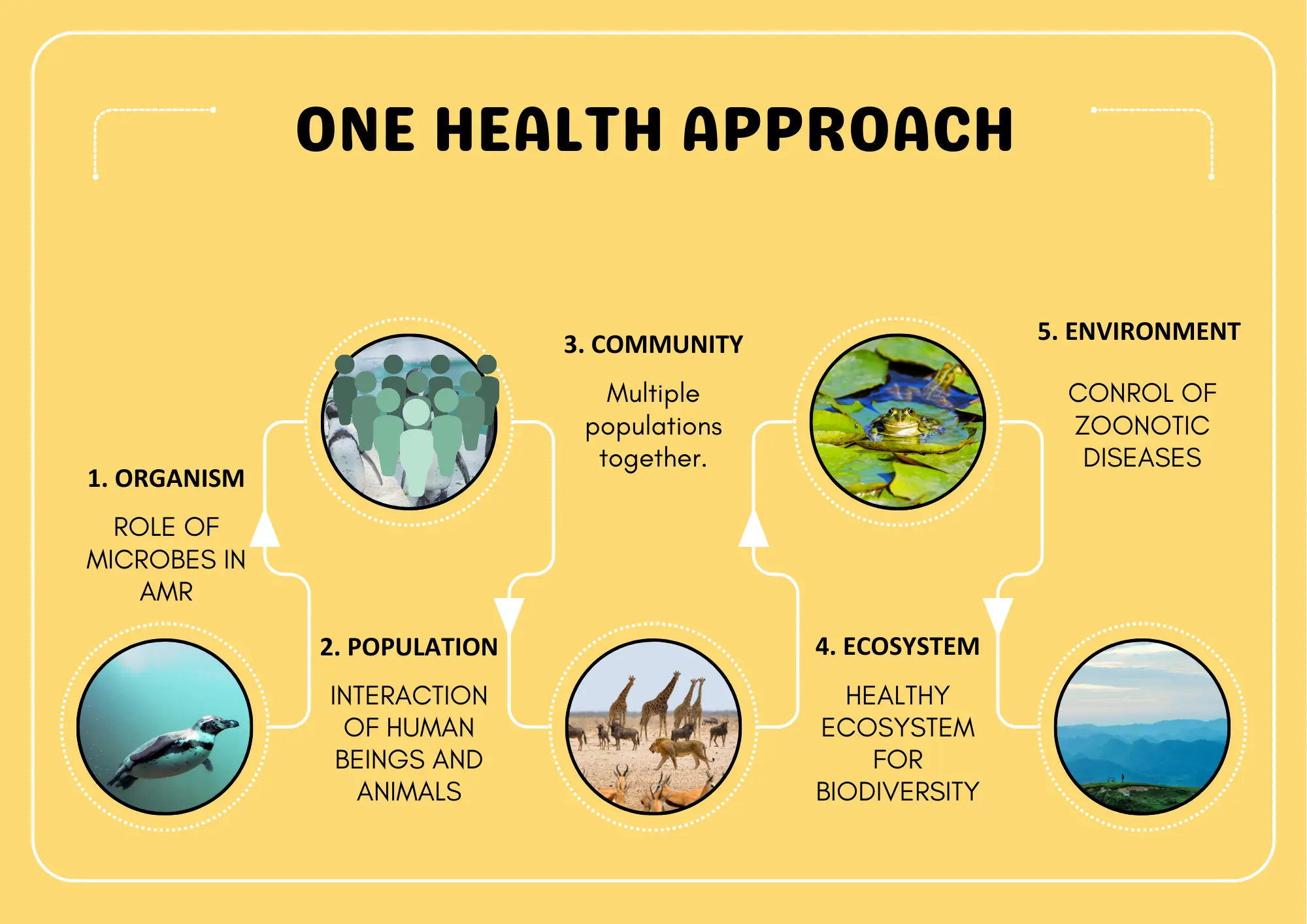
Combating Antimicrobial Resistance Through One Health
Antimicrobial resistance (AMR) is one of the most urgent global health threats, affecting humans, animals, and the environment. Through the One Health approach, efforts to prevent and control AMR can be more effective, as this model emphasizes collaboration across human, veterinary, and environmental sectors. Here’s how One Health contributes to the prevention of AMR:
- Responsible antibiotic use: The One Health initiative encourages responsible antibiotic use in both human and animal healthcare. Misuse of antibiotics—such as over-prescribing in humans or overuse in livestock farming—creates selective pressure, allowing resistant bacteria to thrive. By setting guidelines and promoting awareness, One Health helps establish responsible antibiotic practices across industries to reduce AMR development.
- Antimicrobial Surveillance: Effective AMR prevention relies on early detection and response, which is facilitated by robust surveillance systems across sectors. One Health promotes integrated monitoring of antibiotic use and resistance patterns, allowing human and animal health agencies to detect resistance trends quickly. This coordinated approach enables more responsive actions, such as targeted antibiotic stewardship programs and policy adjustments.
- Improved hygiene and infection control measures: The spread of resistant bacteria can often be minimized through improved hygiene and infection control measures. One Health emphasizes such practices not only in hospitals and healthcare settings but also in agriculture and food production. By reducing infection rates across all environments, there is less need for antibiotics, which in turn lowers the risk of resistance development.
- By integrating human, animal, and environmental health practices, One Health offers a comprehensive strategy for AMR prevention. This collaboration is essential to curbing the spread of antimicrobial resistance and protecting health across all domains.
Conclusion:
The intricate connections among human, animal, and environmental health demand a holistic, collaborative approach to address contemporary health challenges. With increasing pressures on animal populations, a rising need for animal-based protein, and the loss of biodiversity, our interdependence with animals is reshaping global health risks. This interdependence is particularly evident in the spread of zoonotic diseases, which account for about 75% of new emerging infectious diseases in humans over the past three decades. Despite these challenges, traditional health fields have often operated separately, overlooking critical links between human and veterinary medicine.
The One Health approach offers a powerful strategy to bridge these gaps, drawing from insights across disciplines to improve health outcomes for humans, animals, and ecosystems. Rooted in principles that have been advocated by pioneers like William Osler and Rudolf Virchow, One Health promotes collaboration among veterinary, human, environmental, and public health professionals. Through such teamwork, One Health aims to tackle global health issues, foster centers of excellence for interdisciplinary training, and advance scientific knowledge. By embracing this approach, we can more effectively respond to emerging health threats, strengthen health systems, and create a sustainable future that benefits all living beings on our shared planet.
