
What You’ll Learn in This Article
- Review By: Dr. Ayesha Bashir Hashmi
- Review By: Dr. Omar Bashir Hashmi
What You’ll Learn in This Article
- What uterus transplantation is — procedure overview, conditions treated, and how it differs from surrogacy
- Uterus transplant success rates — global statistics: 74% surgical success, 22–83% live birth rates
- Uterus transplant after hysterectomy — eligibility criteria and what patients must know before applying
- Uterus transplant cost — full global breakdown from $18K (Pakistan projected) to $500K (USA)
- Which countries perform UTx — 14 active nations, barriers, and Pakistan’s current status
- Risks to mother and pregnancy — rejection, graft failure, obstetric complications explained
Uterus transplantation is one of the most transformative advances in modern reproductive medicine. For millions of women worldwide living with Absolute Uterine Factor Infertility (AUFI) — whether born without a uterus or having lost one to surgery or disease — carrying a pregnancy was medically impossible until just over a decade ago. Today, with over 135 transplants performed and more than 65 healthy babies born globally, uterus transplantation is rewriting that reality.
This comprehensive, expert-backed guide covers everything you need to know about uterus transplantation — from how the procedure works and who qualifies, to global uterus transplant success rates, eligibility for a uterus transplant after hysterectomy, and a detailed breakdown of uterus transplant cost worldwide including a focused look at uterus transplant cost in Pakistan. For more medically reviewed reproductive health content, visit health-learners.com.
What Is Uterus Transplantation and How Does the Procedure Work?
Quick Answer
Uterus transplantation is a surgical procedure in which a healthy donor uterus is implanted into a woman with Absolute Uterine Factor Infertility (AUFI). Unlike permanent organ transplants, the uterus is a temporary graft — maintained only for one or two pregnancies, then removed to end the need for lifelong immunosuppressive drugs. As of 2025, over 135 transplants have been performed globally, resulting in 65+ live births across 14+ countries.
Uterus transplantation (UTx) is a treatment for Absolute Uterine Factor Infertility (AUFI), a condition that affects approximately 1 in 500 women worldwide and is the only form of female infertility that prevents pregnancy regardless of hormonal or ovarian status. AUFI includes women born without a uterus (most commonly due to Mayer-Rokitansky-Küster-Hauser (MRKH) syndrome), women who underwent hysterectomy due to cancer, postpartum hemorrhage, or fibroids, and women with severe uterine scarring (Asherman’s syndrome) or malformation.
Unlike surrogacy — which involves another woman carrying the child — uterus transplantation allows the recipient to personally experience pregnancy and delivery. This distinction is medically, culturally, and legally significant, particularly in countries where gestational surrogacy is restricted or unavailable.
According to the Cleveland Clinic, uterus transplantation is now an established specialty procedure at high-volume centers, with the first successful live birth achieved by a Swedish team at the University of Gothenburg in 2014. The UK performed its first transplant in August 2023 at Oxford’s Churchill Hospital — a 17-hour surgery between sisters — with a successful birth in February 2025.
Step-by-Step: How the Procedure Works
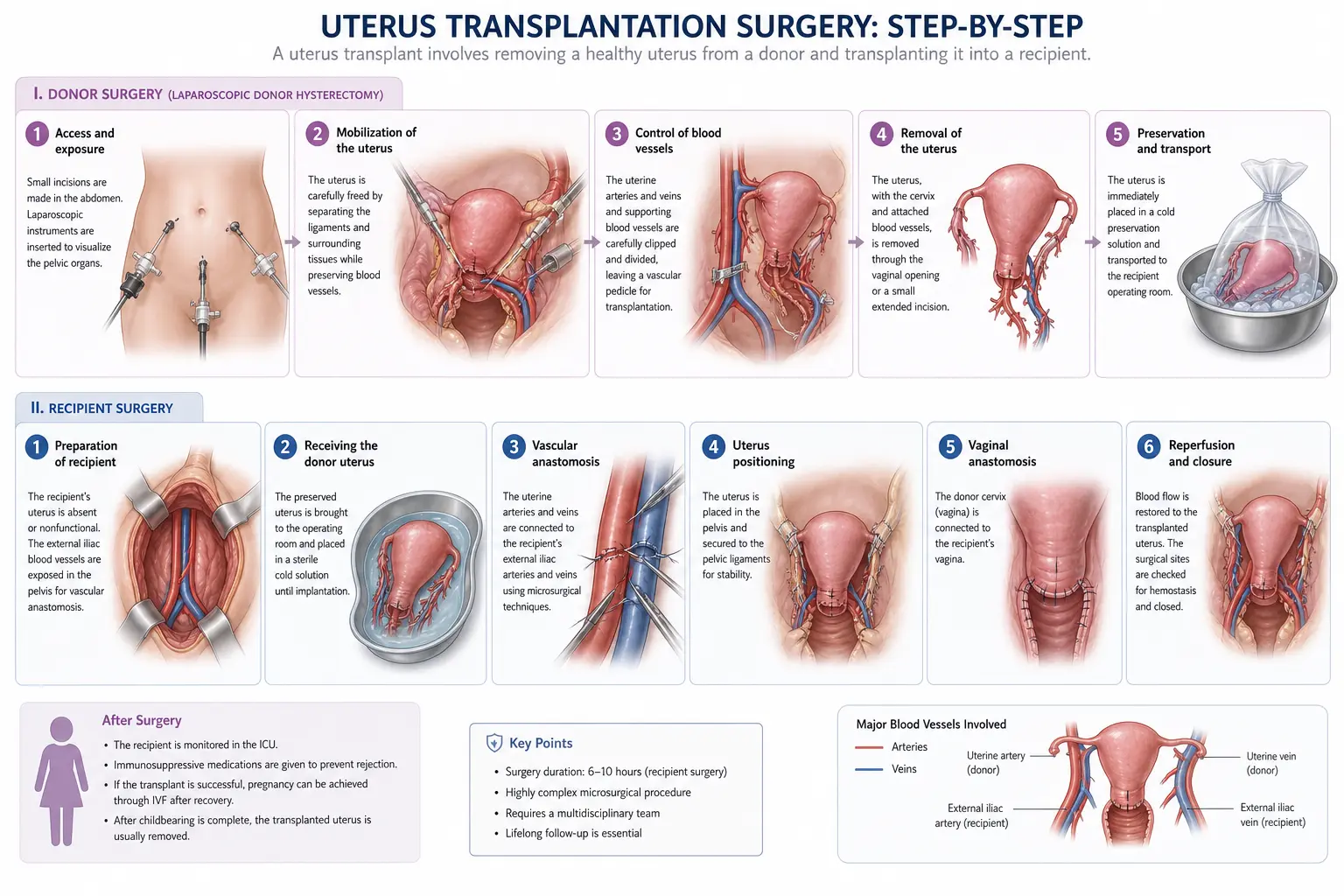
Uterus transplantation is not a single surgery but a multi-year clinical pathway involving a minimum of three major operations:
- Pre-transplant evaluation (6–18 months): Full medical, surgical, psychological, and immunological screening for both donor and recipient. IVF embryo creation and freezing occurs at this stage — before any transplant surgery.
- Donor uterus retrieval (4–6 hours): The donor uterus is removed via open laparotomy (most common), robotic approach (lowest blood loss, longer operative time), or laparoscopy. The uterus, cervix, surrounding ligaments, and vascular pedicles are meticulously preserved.
- Transplant surgery (10–13 hours): The uterus is placed into the recipient’s pelvis and connected to her pelvic vasculature. The cervix is attached to the vaginal cuff. This is the most technically demanding phase.
- Stabilization period (6–12 months): Immunosuppressive medication is started. Regular biopsies and cervical monitoring confirm viability. Return of menstruation is the primary clinical indicator of a functioning graft.
- Embryo transfer (IVF): Frozen embryos are transferred when the graft is confirmed stable. All pregnancies are classified high-risk and managed by specialist obstetric teams. All deliveries are by planned Caesarean section.
- Final hysterectomy: After one or two successful births, the transplanted uterus is surgically removed. This ends the need for immunosuppressive therapy — the planned, intended outcome of the procedure.
Uterus Transplant Success Rate: Global Statistics and Outcomes
Quick Answer
Global uterus transplant success rates (2025): overall surgical success 74%; clinical pregnancy per embryo transfer 36.3%; live birth per embryo transfer 22%; live birth at leading programs up to 83%. Over 65 healthy babies have been born worldwide. Living donor transplants achieve 78% surgical success vs. 64% for deceased donors.
135+
Transplants performed worldwide
65+
Healthy babies born globally
74%
Overall surgical success rate
14+
Countries with active UTx programs
Understanding uterus transplant success rates requires evaluating outcomes at multiple milestones: graft viability, embryo implantation, clinical pregnancy, and live birth. Research published through the National Institutes of Health (NIH) confirms that outcomes are closely correlated with surgical volume and institutional experience.
Among recipients with viable grafts at leading programs, live birth rates have reached 83% — comparable to the cumulative live birth rate after six IVF cycles in women under 35. This benchmark is important for patient counselling: UTx outcomes at expert centers are not significantly inferior to conventional IVF in the appropriate population.
Success by Donor Type
| Donor Type | Surgical Success Rate | Notes |
|---|---|---|
| Living donor | 78% | Higher success; robotic approach reduces blood loss |
| Deceased donor | 64% | Expands access; lower graft survival rate |
Rejection and Graft Failure
Acute rejection occurs in approximately 30–45% of recipients, though most episodes are reversible with adjusted immunosuppressive therapy. Graft failure — requiring uterus removal before pregnancy — occurs in around 15–20% of cases globally. These figures underscore why high-volume, specialized centers consistently outperform general transplant programs.
Key insight: At the most experienced centers (Gothenburg, Baylor, Galaxy Care Pune), UTx is no longer purely experimental. Patients should seek care at accredited, high-volume programs to access the best possible outcomes.
Uterus Transplant After Hysterectomy: Eligibility and What Patients Should Know
Quick Answer
Yes — a uterus transplant after hysterectomy is medically possible in carefully selected patients. Eligibility requires preserved ovarian function or viable frozen embryos, intact pelvic vasculature, no active cancer, healthy cardiovascular status, and age between 20–40. Women with prior cancer must demonstrate confirmed full remission before evaluation begins.
Women who underwent hysterectomies — due to fibroids, endometriosis, gynecological cancer, postpartum hemorrhage, or other conditions — represent a substantial proportion of candidates evaluated for uterus transplantation. A uterus transplant after hysterectomy is feasible when specific anatomical and clinical criteria are met.
Eligibility Criteria for Post-Hysterectomy Patients
- Preserved ovarian function or viable pre-frozen embryos created via IVF before transplantation
- Healthy cardiovascular system capable of tolerating major, prolonged surgery and long-term immunosuppression
- Intact pelvic vasculature — sufficient blood vessel anatomy in the pelvis for successful graft anastomosis
- No active cancer or systemic disease — oncology patients must provide documented full remission and acceptable recurrence risk assessment
- Age 20–40 years — the standard clinical window used by most international programs
- Psychological fitness — verified by formal mental health evaluation; ongoing psychosocial support required throughout the transplant journey
Women whose hysterectomy also involved oophorectomy (removal of ovaries) will require donor eggs or previously frozen embryos for IVF, plus hormone replacement therapy irrespective of UTx. This adds a layer of coordination with a reproductive endocrinologist.
Important: Uterus transplantation remains primarily within research protocols at specialist centers. The evaluation process typically takes 6–18 months. Begin consultation at an accredited reproductive surgery program. Find expert guidance at health-learners.com/reproductive-health.
Which Countries Perform Uterus Transplantation? Global Access and Barriers
As of 2025, uterus transplantation has been successfully performed in more than 14 countries: Sweden, USA, Brazil, Serbia, India, Czech Republic, China, Lebanon, Germany, Italy, Spain, France, UK, and Australia. The field has grown rapidly since the first live birth in 2014, with over 135 transplants and 65+ babies born globally.
Key Milestones by Country
| Country | Status | Notable Detail |
|---|---|---|
| Sweden | Active — pioneer | First live birth worldwide (2014), University of Gothenburg |
| USA | Active | Baylor University Medical Center is a leading high-volume program |
| India | Active | Galaxy Care Hospital, Pune — most accessible center for South Asian patients |
| UK | Active (2023) | Churchill Hospital Oxford; first UK birth February 2025 |
| Brazil | Active | First deceased-donor UTx resulting in birth (2018) |
| Pakistan | Not yet — academic interest | Publications from JSMU Karachi (2023); patients traveling to India |
Barriers to Wider Adoption
Countries without established UTx programs typically face a convergence of barriers. The procedure requires a highly specialized multidisciplinary team including transplant surgeons, reproductive endocrinologists, gynecologists, and immunologists — all at one institution. Additional barriers include: the experimental regulatory classification of the procedure in many jurisdictions; the legal and ethical frameworks around organ donation (uterus donation is not covered under standard transplant law in most countries); the high infrastructure and training cost; the ethical debate around immunosuppression for a non-lifesaving procedure; and the absence of insurance coverage, which limits access to privately funded patients.
Pakistan — Current Status and Outlook
No uterus transplant has been documented inside Pakistan as of 2025. However, the country shows meaningful academic engagement: a paper on live-donor uterine transplant was published in 2023 by authors from Jinnah Sindh Medical University (Karachi) and Karachi Medical and Dental College, signalling active research interest. Meanwhile, Galaxy Care Hospital in Pune, India — one of Asia’s highest-volume UTx centers — reports a waitlist that includes patients from Pakistan, Bangladesh, UAE, and the USA.
For Pakistani patients seeking uterus transplantation today, India (Pune and Chennai) represents the most geographically and financially accessible option. Turkey is emerging as an alternative for medical tourism. A domestic Pakistani program may develop within the next 5–10 years as regulatory and infrastructure barriers are addressed.
Uterus Transplant Cost: Global Breakdown and Pakistan-Specific Guide
Quick Answer
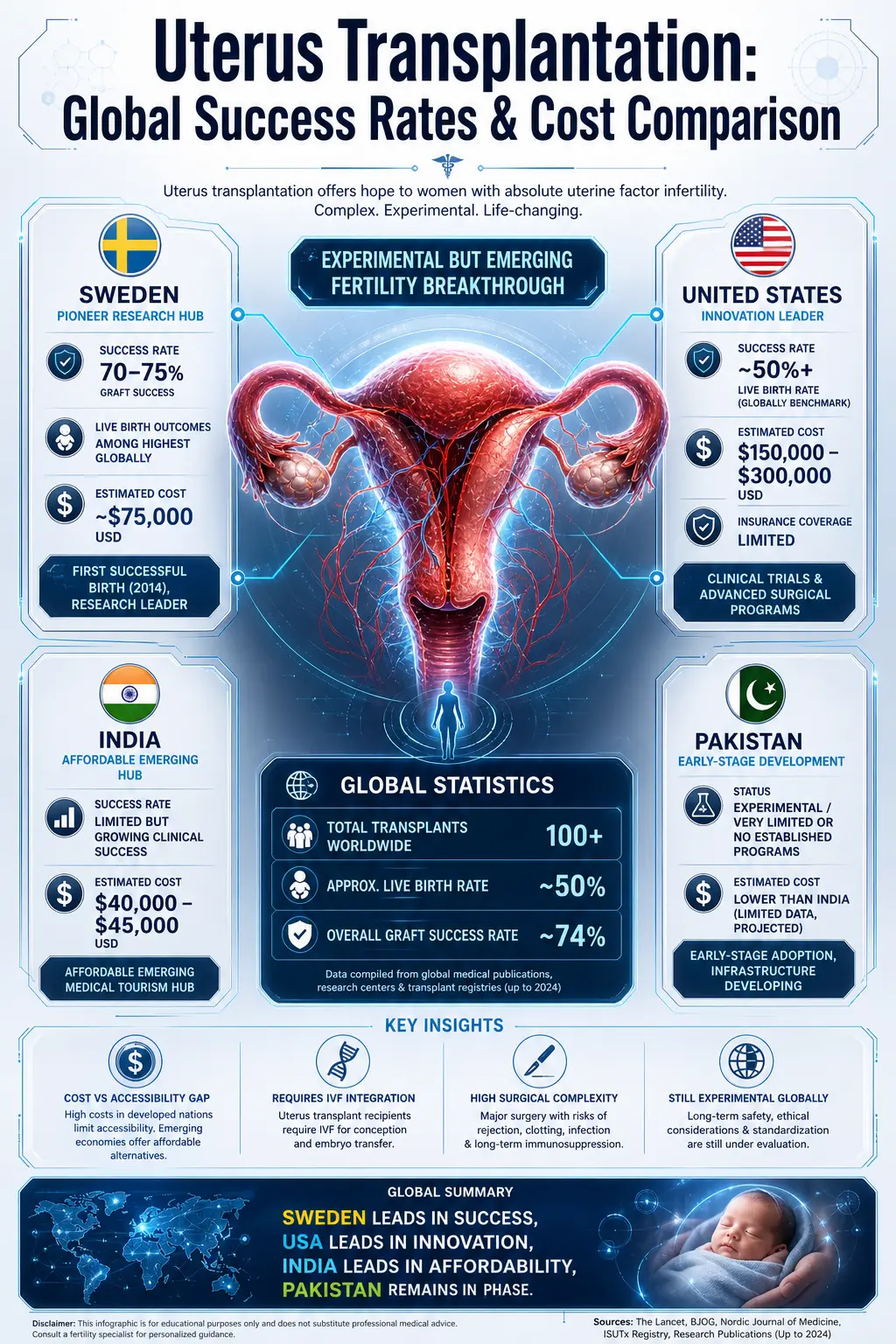
Uterus transplant cost ranges from $200,000–$500,000 USD in the USA; €80,000–€200,000 in Europe; €50,000–€100,000 in Turkey; and $30,000–$60,000 in India. Uterus transplant cost in Pakistan is projected at PKR 5,000,000–15,000,000 (~$18,000–$55,000 USD) once a program is established. Pakistani patients currently travel to India or Turkey.
| Country / Region | Estimated All-In Cost | Notes |
|---|---|---|
| United States | $200,000 – $500,000 USD | Research trials may subsidize; access very limited outside academic centers |
| Europe (Sweden, Germany, Czech Rep.) | €80,000 – €200,000 | Some public health systems partially offset costs for research participants |
| Turkey | €50,000 – €100,000 | Growing medical tourism hub; popular option for South Asian and Middle Eastern patients |
| India (Pune / Chennai) | $30,000 – $60,000 USD | Most accessible for Pakistani patients; Galaxy Care Hospital Pune is a leading center |
| Pakistan (projected) | PKR 5M – 15M (~$18K–$55K) | No established program yet; patients referred abroad |
Uterus Transplant Cost in Pakistan
Understanding uterus transplant cost in Pakistan requires acknowledging that no domestic program exists yet. Based on the cost infrastructure of comparable advanced surgical procedures in Pakistan, projected costs — if a program launches — would likely range from PKR 5,000,000 to PKR 15,000,000 (~$18,000 to $55,000 USD) for the primary surgery, hospitalization, donor evaluation, and initial post-operative care. Annual ongoing costs for immunosuppressants and IVF cycles would add approximately PKR 2,000,000 to PKR 5,000,000 per year.
For Pakistani patients currently seeking the procedure, India remains the primary referral destination. Medical tourism packages to Turkey are also available, typically ranging from $55,000 to $90,000 USD all-inclusive. When comparing packages, always verify that the quoted price includes: IVF cycles, immunosuppressive medication for year one, all three required surgeries (transplant, Caesarean, hysterectomy), and specialist obstetric monitoring throughout pregnancy.
Pakistan tip: Always request an itemized cost breakdown. Many quoted prices exclude IVF cycles, year-two immunosuppressants, the final hysterectomy, or return travel. No public insurance in Pakistan or the regional countries currently covers uterus transplantation.
Risks to the Mother and Subsequent Pregnancies
Uterus transplantation carries a distinct set of risks that differ from both standard organ transplantation and conventional pregnancy. The World Health Organization’s reproductive health framework emphasizes that patients must be fully informed of these risks before beginning the transplant pathway.
Surgical and Graft Risks
- Acute rejection (30–45%): Most common complication; majority are reversible with adjusted immunosuppression
- Graft failure (15–20%): Requires uterus removal before pregnancy; higher rates in deceased-donor transplants
- Vascular complications: Thrombosis, stenosis, or anastomosis failure — particularly in the early post-operative period
- Infection risk: Elevated throughout the immunosuppressive period; vigilant monitoring required
- Immunosuppressant side effects: Renal strain, metabolic changes, elevated infection susceptibility — sustained for the full duration of graft retention
Obstetric Risks
All pregnancies following uterus transplantation are managed as high-risk pregnancies. Elevated rates of hypertensive disorders of pregnancy and preterm birth are documented. However, the median gestational age approaches 37 weeks — near full term — and critically, no increased incidence of congenital malformations has been found among the 65+ infants born via transplanted uteruses worldwide. All deliveries are by planned Caesarean section.
Hormonal Considerations After Hysterectomy
A commonly misunderstood aspect: uterus transplantation does not affect hormonal function. UTx recipients retain their ovaries, so estrogen and progesterone production continues normally. Women who had both ovaries removed alongside their hysterectomy (bilateral oophorectomy) are typically already on hormone replacement therapy and will require donor eggs or pre-frozen embryos for the IVF stage — this is coordinated separately from the transplant itself.
Key Takeaways
Frequently Asked Questions About Uterus Transplantation
What is uterus transplantation?
Uterus transplantation (UTx) is a surgical procedure in which a healthy uterus from a living or deceased donor is implanted into a woman with Absolute Uterine Factor Infertility (AUFI). It is a temporary graft — retained only for one or two pregnancies — then surgically removed to end immunosuppressive therapy. Over 135 transplants have been performed globally and 65+ healthy babies born as of 2025.
What is the uterus transplant success rate?
Global uterus transplant success rates (2025): overall surgical success 74%; clinical pregnancy per embryo transfer 36.3%; live birth per embryo transfer 22%. At leading programs, live birth rates reach 83%. Living donor transplants achieve 78% surgical success vs. 64% for deceased donors.
Can you get a uterus transplant after a hysterectomy?
Yes, in carefully selected cases. Eligibility for a uterus transplant after hysterectomy requires: preserved ovarian function or viable frozen embryos, intact pelvic vasculature, no active cancer (remission required for prior cancer patients), healthy cardiovascular status, and age 20–40. The evaluation process takes 6–18 months.
How much does a uterus transplant cost?
Uterus transplant cost varies widely: United States $200,000–$500,000 USD; Europe €80,000–€200,000; Turkey €50,000–€100,000; India $30,000–$60,000 USD. These are all-in estimates including surgery, hospitalization, initial immunosuppressants, and one IVF cycle. Always verify that IVF, ongoing medication, and the final hysterectomy are included in any quoted price.
What is the uterus transplant cost in Pakistan?
No established uterus transplantation program exists in Pakistan as of 2025. Projected cost if a domestic program launches: PKR 5,000,000–15,000,000 (~$18,000–$55,000 USD) for surgery plus PKR 2,000,000–5,000,000/year for ongoing care. Currently, Pakistani patients are referred to Galaxy Care Hospital, Pune (India) or centers in Turkey. Medical tourism packages to Turkey range from $55,000–$90,000 USD all-inclusive.
Is uterus transplantation available in Pakistan?
Not yet as of 2025. No documented UTx has been performed inside Pakistan. However, Pakistani clinicians at Jinnah Sindh Medical University (Karachi) published research on UTx in 2023, reflecting active academic interest. Pakistani patients are currently seeking the procedure at Galaxy Care Hospital, Pune — the nearest high-volume center. A domestic program may emerge within the next 5–10 years as regulatory frameworks develop.
What are the risks of uterus transplantation?
Key risks include: acute rejection (30–45%, most reversible); graft failure requiring removal (15–20%); vascular complications; infection from immunosuppression; hypertensive disorders in pregnancy; and elevated preterm birth rates. Critically, no increased incidence of congenital malformations has been found in babies born via transplanted uteruses. All UTx pregnancies are managed as high-risk.
Does uterus transplantation affect hormones or cause early menopause?
No. UTx recipients retain their ovaries, so hormonal function — including estrogen and progesterone production — is unaffected. Uterus transplantation does not cause early menopause. Women who had bilateral oophorectomy alongside their hysterectomy are already on hormone replacement therapy and will need donor eggs for IVF, which is arranged separately from the transplant.
References and Sources
- Cleveland Clinic — Uterus Transplant: Overview, Eligibility and Procedure
- National Institutes of Health (NIH) — Uterine Transplantation: Outcomes and Research
- World Health Organization (WHO) — Reproductive Health Framework
