

The world of research is changing fast, thanks to artificial intelligence (AI). But with so many AI tools out there, how do you pick the best ones? Do you know about the latest AI tools that can change how you work with research?
As we get closer to 2025, research tools are going to change a lot. AI will make things like literature reviews and data analysis much easier. In this article, we’ll look at the top 7 AI tools every researcher should know about in 2025.
Key Takeaways
- AI is changing research, making it more efficient and accurate.
- The top 10 AI tools for researchers will change how we work with data.
- These tools can make literature reviews easier, automate data analysis, and help with writing and teamwork.
- Researchers need to keep up with the latest AI tools to stay ahead.
- Finding the right AI tool for your research is key to being efficient and reaching your goals.
Understanding AI Tools in Modern Research
The world of academic research has changed a lot in recent years. This change is thanks to the fast growth of artificial intelligence (AI) technology. AI tools are now key for researchers, helping them work more efficiently and find new insights.
It’s important to know how AI has changed research. We need to understand the evolution of research technology. We also need to know what makes the best AI tools for academic work.
Evolution of Research Technology
In the last ten years, research technology has changed a lot. It has moved from old manual methods to new digital tools. The rise of ai tools for academic research has changed how researchers find, analyze, and share information.
These tools help researchers do more than before. They can do automated literature reviews and AI-powered data visualization. This lets researchers explore new areas and find important discoveries.
Impact of AI on Academic Research
The use of best AI tools for research has changed academic research a lot. It makes researchers work better together and make smarter choices. AI tools can handle huge amounts of data, find patterns, and give insights that humans can’t.
This has led to big steps forward in fields like medicine, engineering, and social sciences. Researchers use AI to solve hard problems and bring new ideas.
Key Features to Look for in Research AI Tools
When looking for the best AI tools for research, it’s important to know what to look for. Look for tools that can do natural language processing for literature reviews, extract and analyze data, and manage citations. Also, look for tools that help teams work together and give feedback right away. These AI tools are used within ethical approach of researcher.
By checking these features, researchers can find the AI tools for academic research that fit their needs best.
Best AI Tools for Researchers: A Comprehensive Overview
The world of research technology is changing fast. New AI tools for researchers are making work easier, faster, and more insightful. These tools, from natural language processing to data visualization, are changing how scholars and scientists work. Let’s look at some top AI solutions that are changing research.
| AI Tool | Key Features | Target Users |
|---|---|---|
| Anthropic’s Claude | – Natural language processing – Literature review assistance – Data analysis and report writing | Researchers across disciplines |
| Dimensions | – Research intelligence – Trend identification – Scholarly data analysis | Academics, policymakers, and research organizations |
| Tableau and Power BI | – Advanced data visualization – AI-powered pattern recognition – Interactive dashboards | Researchers in data-driven fields |
| Scholarcy and Iris.ai | – Research paper summarization – Key findings extraction – Literature navigation | Researchers across disciplines |
| Overleaf and Zotero | – Collaborative document writing – Citation management – Real-time feedback and editing | Researchers and academic teams |
These are just a few examples of the AI tools for researchers changing research.
AI-Powered Literature Review and Analysis Tools
Researchers now have AI tools to help with literature reviews and analysis. These tools use advanced natural language processing (NLP) to change how we work with academic texts.
- Semantic Scholar
- Scinapse
- Consensus
- Perplexity
- R Discovery
- Scite
- CILYNK
- Undermind.ai
Natural Language Processing Capabilities
AI tools are great at understanding academic language. They help researchers find important insights quickly. NLP algorithms sort through lots of text, finding key concepts and trends.
GPT’s for literature search
- INSIGHT: Access up-to-date PubMed articles, clinical trials and NIH grants
- SCISPACE: SciSpace aids in conducting literature reviews by helping researchers identify gaps in existing studies, thus guiding future research directions. Also it helps in data management.
- CONCENSUS: Consensus provides extensive research coverage to doctors, researchers and students.
- ScholarAI: ScholarAI simplifies research tasks, saving your time and helping you overcome language barriers with multilingual support. It automate data visualization, writing, and citation management.
Data Extraction Features
These AI tools for research paper writing also extract data automatically. They use smart algorithms to find and pull out important data, saving researchers a lot of time.
Citation Management
The best AI tool for research works well with citation systems. It can make accurate citations and bibliographies, helping researchers follow their chosen styles easily.
AI helps researchers move faster through the literature, find insights more accurately, and focus on sharing their findings. It makes tasks like data extraction and citation management easier. Following are tools for original citation.
- Openscholar.allen.ai: It’s a large language model integrated with millions of research papers. And it’s totally free.
- Undermind.ai: Undermind has an option for timeline of published papers and the citation network.
- SearchGPT: Chat gpt just launched searchGpt with authentic citations.
Research Writing and Editing AI Assistants
The world of academic research has changed with AI tools for writing and editing. These tools are now key helpers for researchers. They make writing easier and improve the quality of research papers.
The best AI tools for research writing give instant feedback on grammar, syntax, and style. They use natural language processing to check the text. This helps catch errors and improve the writing, meeting high academic standards.
AI tools for research paper writing also help with formatting and organizing papers. They manage citations, create tables, and insert figures. This saves time and reduces errors, letting researchers focus on their content and analysis.
| AI Tool | Key Features | Pricing |
|---|---|---|
| Grammarly | Grammar and spelling correction Vocabulary enhancement Plagiarism detection | Free and Premium plans available |
| Hemingway App | Readability analysis Sentence structure improvement Passive voice detection | Free web-based app |
| PerfectIt | Consistency checking Style guide adherence Document formatting | Subscription-based pricing |
| Paperpal | Advanced AI grammar checker and online academic writing tool | Free web-based app |
| Jenni | AI writing assistant that supercharge your research | Free online |
AI tools are changing academic writing for the better. They help researchers work more efficiently and improve their papers. This leads to more impactful research in their fields.
Data Analysis and Visualization AI Solutions
In academic research, analyzing and visualizing data is crucial. AI has changed how we manage and understand data. The best AI tools for research offer many solutions to make data analysis and visualization easier. This helps researchers find important insights quickly.
Statistical Analysis Tools
The top AI tools for research are great at statistical analysis. They can do everything from simple stats to complex models. This saves researchers time, letting them focus on what the data means.
- DATA ANALYSIS GPT
- STATISTICS TEST GPT
- RESEARCH PAPER ANALYZER
- EXCEL ANALYST GPT
- STATS GUIDE FOR DATA SCIENCE
- DATA DETECTIVE
- CHART GPT
Visual Data Representation
The best AI tools also excel in making data look good. They create charts and graphs that show research findings clearly. These tools help researchers share their data in a way that grabs attention.
Pattern Recognition Features
AI tools for research can find patterns in data that we might miss. They spot trends and unusual data points. This helps researchers understand their data better and draw deeper conclusions.
| AI Tool | Statistical Analysis Capabilities | Visualization Features | Pattern Recognition |
|---|---|---|---|
| MyRA | Thematic analysis for qualitative research | MyRA automatically quantifies your qualitative data, providing detailed metrics | Trend detection, anomaly identification |
| Julius | Analyze your data with computational AI. | Infographics, geospatial data visualization | Predictive modeling, outlier detection |
| tsibble (R programming) | Time series analysis | dynamic data exploration | Association rule mining, neural network models |
Using AI for data analysis and visualization can greatly improve research. The best AI tools help researchers find new insights and make better decisions. This leads to progress in their fields.
AI Tools for Research Paper Summarization
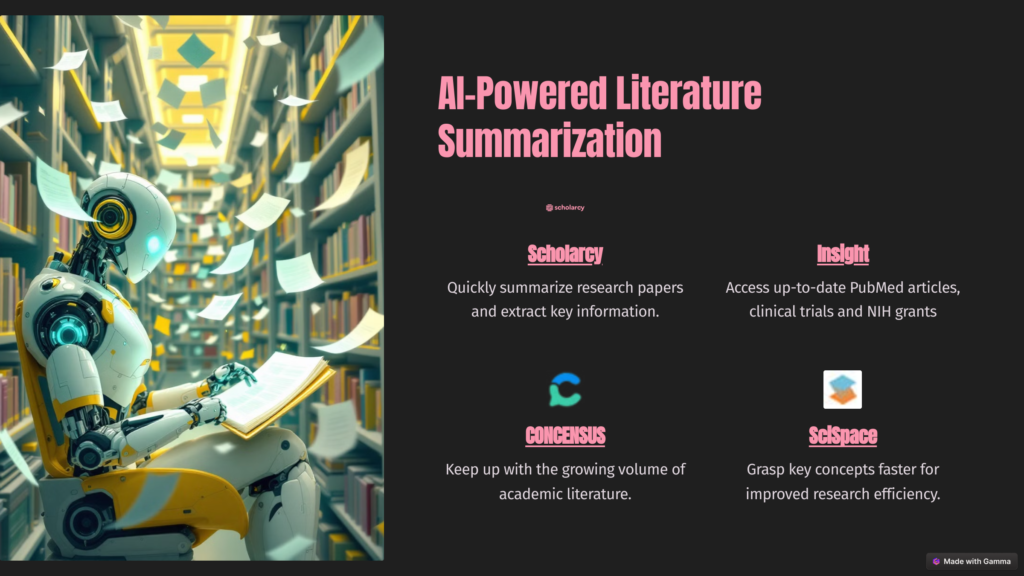
In today’s fast-paced academic world, summarizing complex research papers quickly and accurately is key. AI tools have changed this game, offering researchers tools to make their work easier. They help with literature reviews and analysis.
AI tools for summary of research paper use advanced algorithms to understand and summarize academic papers. They turn long papers into short, useful summaries. This saves researchers time and helps them understand topics better.
Looking for the best ai tools for researchers? Here are some important features to look for:
- Automated Summarization: These tools create detailed yet brief summaries. They focus on the paper’s main findings, methods, and conclusions.
- Contextual Understanding: AI tools that really get the text’s meaning, not just keywords or sentences.
- Customizable Outputs: You can adjust the summary’s length and detail to fit your needs.
- Integration with Research Workflows: They work well with tools you already use, making research smoother.
Using these ai tool for summary of research paper, researchers can save hours. They get a better grasp of the literature and speed up their research.
| AI Tool | Key Features | Pricing |
|---|---|---|
| Scholarcy | Automated paper summaries, citation management, task tracking | Free trial, starting at $9/month |
| Iris.ai | AI-powered literature mapping, topic discovery, recommendation | Free trial, starting at $49/month |
| Arxiv Sanity Preserver | Paper recommendation, search, and discovery | Free |
Collaborative Research Platforms with AI Integration
Artificial intelligence (AI) has changed how researchers work together and manage their projects. New AI tools have made team work easier, improved project management, and allowed for quick editing and feedback.
Team Collaboration Features
AI has made it easier for research teams to talk and work together. These platforms have features like:
- Secure cloud-based file sharing and storage
- Real-time document co-editing and version control
- Instant messaging and video conferencing functionalities
- Automated task assignment and progress tracking
Project Management Capabilities
AI has made managing research projects easier. Now, platforms offer tools like:
- Dynamic project planning and scheduling
- Resource allocation and budget management
- Deadline tracking and milestone monitoring
- Customizable reporting and analytics
Real-time Editing and Feedback
AI has changed how researchers get and use feedback. These tools now offer:
- Instant grammatical and stylistic suggestions
- Automated citation formatting and reference management
- Peer review and annotation capabilities
- Collaborative editing and version control
Choosing the Right AI Research Tool for Your Needs
The world of academic research has changed a lot with AI tools. They help with everything from finding literature to analyzing data. But, with so many best AI tool for research and AI tools for research paper writing out there, picking the right one can be tough.
When looking at AI research tools, think about what your project needs. Do you need help finding and organizing information, or do you want to create detailed data visualizations? Also, do you work with a team, or do you handle all the research yourself?
- Know what you want to achieve: Define your project’s goals and the tasks you need to do. This will help you find the right AI tool for your needs.
- Check what the tool can do: Look at each AI tool’s features, like its ability to understand and extract data, and how it handles citations.
- Think about your team’s needs: If you work with others, choose a tool that makes it easy to edit and manage projects together.
- Choose a tool that’s easy to use: The tool should be simple to use so you can focus on your research without getting stuck on complicated interfaces.
- Make sure it fits with what you already use: The AI tool should work well with your current software and platforms. This saves time and effort.
By carefully choosing an AI research tool that fits your needs, you can make the most of these new technologies. This will improve your research experience greatly.
| AI Research Tool | Key Features | Ideal for |
|---|---|---|
| Semantic Scholar | AI-powered literature search, citation management, and research paper summarization | Researchers focused on efficient literature reviews and knowledge synthesis |
| Iris.ai | AI-driven research paper recommendations, concept mapping, and research topic exploration | Researchers seeking to discover relevant literature and uncover new research directions |
| Elsevier’s ScienceDirect | AI-enhanced search, personalized recommendations, and interactive data visualization | Researchers across various disciplines requiring robust data analysis and visualization tools |
By considering your research goals, looking at AI tools, and matching them with your team’s needs, you can find the best tool for your academic work.

Conclusion
AI tools have changed the research world, giving researchers new powers. They help with everything from reading and analyzing papers to making data look good. This makes research faster and more effective.
AI lets researchers dig deeper into their studies and find new insights. It also helps them work better with others. Whether you’re new or experienced, the right best ai tools for researchers can make your work better.
When you look at the ai tool for research world, find what fits your needs. Using these tools can open up new ways to explore and grow your field. It helps you make a real difference in knowledge.
FAQ
What are the key features to look for in research AI tools?
Look for AI tools with natural language processing and data extraction. They should also integrate with citation management and offer writing and editing help. Advanced data analysis and visualization, along with research paper summarization, are also important.
How can AI tools enhance literature review and analysis?
AI tools use natural language processing to quickly sort through research papers. They extract key information and manage citations. This helps researchers review literature more efficiently.
What are the benefits of using AI assistants for research paper writing and editing?
AI tools improve research paper quality by suggesting grammar and style changes. They automate formatting and provide feedback in real-time. This enhances the writing and editing process.
How can AI tools help with data analysis and visualization in research?
AI tools offer advanced statistical analysis and intuitive data representation. They recognize patterns in data, helping researchers make informed decisions.
What are the advantages of using AI tools for research paper summarization?
AI summarization tools save time by condensing complex papers into brief summaries. This makes it easier to understand key findings and implications.
How can collaborative research platforms with AI integration benefit research teams?
AI-powered platforms enhance team collaboration and project management. They offer real-time editing and feedback, streamlining the research process and improving teamwork.
What should researchers consider when choosing the right AI research tool for their needs?
Researchers should evaluate their specific needs, such as literature review, writing, data analysis, or collaboration. Choose tools that match their research goals and workflows.
